
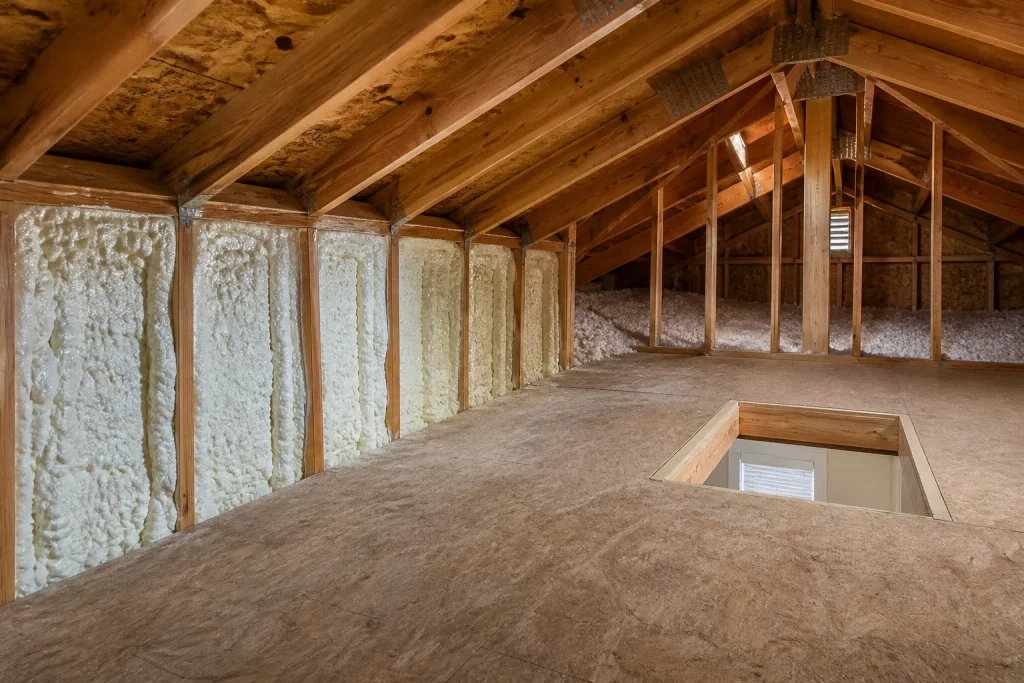
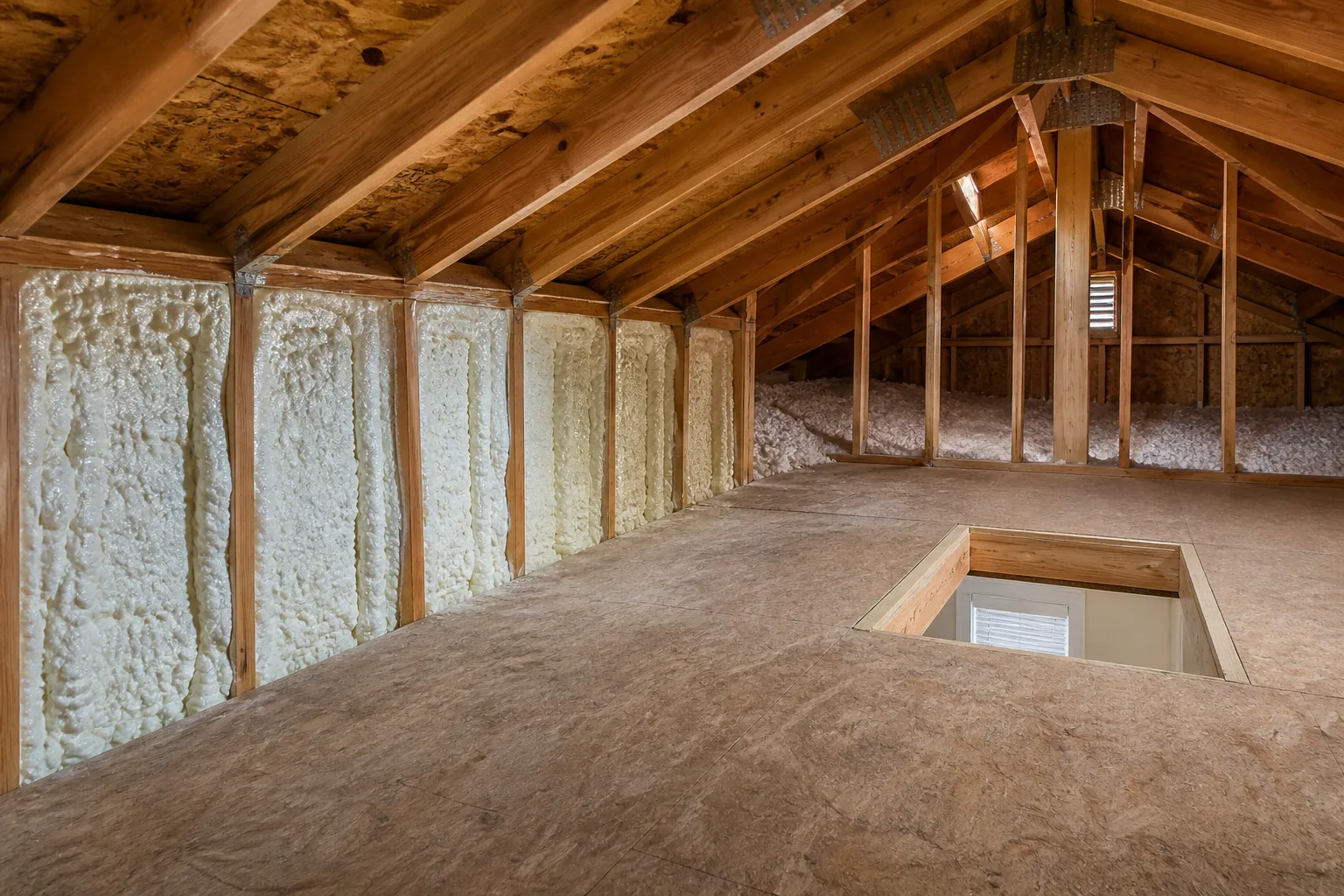
Spray Foam Insulation: Repair or Replace? How Henderson Homeowners Decide
You don’t decide this by age or by looking at it. You decide by diagnosing which of three failure modes you actually have, because two of them are repairable and one isn’t. Spray foam that shrank and left gaps can usually be saved with targeted re-application. Foam that delaminated from the roof deck or cured off-ratio comes out. Getting that call wrong is expensive in both directions, and in Henderson’s climate the wrong call shows up fast.
If you’d rather have someone with a blower door make the determination than guess from a flashlight, call (844) 320-5338. A live person answers around the clock, and the written price comes before anything gets touched.
A spray foam job that smells like cat urine or fish two years after install isn’t just unpleasant. It’s the chemical signature of an off-ratio mix, meaning too much isocyanate or too much polyol went into the gun. That same imbalance wrecks the foam’s structural and thermal properties. Topcoats, patches, and encapsulation sprays won’t fix a bad core, and here’s the mistake we see most in Henderson: a homeowner calls a crew to “freshen up” failing foam, the crew sprays another inch over the top, and the smell and the air loss are both back within two years.
What Are the Three Ways Spray Foam Fails?
Every failed spray foam assembly we’ve opened in Henderson falls into one of these categories, and each has a different diagnostic and a different remediation path.
- Shrinkage and gap formation. Low-density open-cell foam and some older closed-cell formulations contract as they cure and continue moving through seasonal cycles. The result is a visible gap along top plates, rim joists, or around penetrations. This is the repairable kind. Diagnostic: blower-door test plus a visual walk of the assembly.
- Delamination from the substrate. The foam has pulled away from the roof deck or framing, leaving a hidden channel where air moves freely behind a surface that looks intact. This one is serious because it’s invisible from inside the house. Diagnostic: visual inspection with probing at edges and seams, plus blower-door readings taken before and after a controlled depressurization.
- Off-ratio cure. The A and B components met at the wrong ratio in the gun, often because the proportioner was miscalibrated or the drums were cold. The foam cures brittle, discolored, or tacky and never reaches its rated R-value. Diagnostic: the smell is the first clue, and an FTIR (Fourier-transform infrared spectroscopy) analysis of a core sample tells you definitively which component is in excess.
In our experience, most of the “replace it” quotes Henderson homeowners get are for category one. Most of the “just patch it” advice is for category two. That gap is where money gets wasted.
Related services in Henderson: Spray Foam Insulation in Henderson covers what a properly installed assembly looks like before failure ever enters the conversation.
How Do You Tell If Spray Foam Can Be Repaired or Has to Come Out?
Run a blower-door test on the assembly, and look at the gap-adjusted ACH50. ACH50 means air changes per hour at 50 pascals of pressure, a standardized measure of how leaky the building envelope is. If a previously foamed assembly reads above roughly 0.5 ACH50 after you account for the gaps you can see, that’s the practical trigger for evaluating replacement rather than injection repair. Below that number, targeted re-application usually gets you back to where the foam was supposed to be.
Here’s what that looks like in practice:
- Baseline blower-door reading. Before anyone touches the foam, measure the whole envelope. Write the CFM50 number down.
- Visual and probe inspection. Walk the roof deck and framing from the attic. Probe seams with a thin blade. Foam that moves or reveals a gap behind it has delaminated.
- Core sample if the smell is present. Send it for FTIR if the odor is chemical rather than musty. That determines off-ratio versus microbial growth from trapped moisture, which are completely different problems.
- Compare to the install documentation. A legitimate installation should have a substrate temperature reading, mix ratio, and thickness recorded at the time of install. If the original installer can’t produce those, that’s a finding.
We publish before-and-after blower-door readings on every job we do. Not because it’s a nice touch, but because it’s the only honest way for a homeowner to know whether the money they spent actually changed anything. On a recent vaulted-ceiling job near Green Valley, the pre-sealing reading was 3,900 CFM50 and the post-sealing reading was 2,050. That delta is the work.
Why Does Spray Foam Delaminate Faster in Henderson Than Elsewhere?
Because of the roof deck temperature swing. Henderson roof decks swing from around 50°F on a winter night to 165°F or higher in July sun, and that’s a difference of well over 100 degrees on the same piece of plywood within months. Foam bonded to that deck is being pushed and pulled every season, and the bond sees stress that a roof deck in a moderate climate simply never receives.
That cycling accelerates delamination in two specific places:
- Vaulted ceilings with closed-cell foam directly on the underside of the roof sheathing. This is the worst-case assembly in Henderson, because there’s no vented buffer between sun and foam.
- Attics where the substrate temperature wasn’t checked before spraying. Most manufacturers specify a minimum surface temperature around 50°F, and below that the foam can skin over before it bonds. A winter install on a cold deck is a slow-motion delamination.
We’ve pulled foam off a garage ceiling near Anthem where the substrate had clearly been sprayed cold in February. The top inch had skinned and cured; the underside was still tacky and unattached. Two winters later the homeowner was heating the neighborhood.
If you’re seeing soft foam or a hollow sound when you tap the ceiling, that’s worth a diagnostic before summer. Attic Insulation in Henderson lays out what a properly sealed attic assembly should look like in this climate.
What Should Be in a Written Scope Before You Authorize Foam Removal?
A four-part document, in writing, before anyone starts. Under our Haven Standard, no work starts without a written price and a written scope, and foam removal is exactly the kind of job where you need it.
- Substrate condition assessment. What’s under the foam, and what state is it in? If the plywood has rot or moisture damage, the removal scope has to address that or you’re reinstalling over a problem.
- Cubic footage of foam to be removed. Not square feet of ceiling. Cubic feet, because that’s what you’re paying to remove and dispose of. Ask for the number.
- Disposal method. Foam removal generates a lot of debris, and disposal rules vary. Get the method in writing.
- The air-seal and re-insulation specification that follows. This is the part people forget. Removal without a specified assembly to put back is half a job. You want the air sealing of top plates, can lights, and penetrations spelled out, then the insulation product and R-value named. We source from Johns Manville, Knauf, Rockwool, CertainTeed and others as the assembly calls for, and the written scope names which one.
When to call a pro: if the foam is delaminated, off-ratio, or the blower-door number is above that ACH50 threshold, call. This is not a homeowner job. Removal and re-installation involve chemical exposure, air quality, and a building envelope that has to work right after you leave. Those aren’t conditions where a weekend attempt is a reasonable plan.
What If the Original Installer Used an Uncertified Mix or Skipped the Temperature Check?
Document the finding carefully, because it changes what happens next with your warranty. If the original installation used an off-ratio mix or skipped the substrate temperature check, you want a written record of what the inspection found: the FTIR result, the substrate temperature evidence, the delamination locations, and the blower-door readings.
What that documentation does for you:
- It establishes whether the failure is installer error or product defect. Those go to different warranty routes, and the difference matters.
- It gives the manufacturer something to evaluate. Most spray foam systems are third-party products (Icynene, Demilec, and others) and their warranties depend on documented installation conditions.
- It protects you if you pursue a claim. Without a written record, a warranty claim is your word against a contractor’s memory of a job from three years ago.
If the installer can’t produce substrate temperature and mix ratio records, that itself is the finding. Under Haven Standard: Have it in writing. A professional who can’t produce documentation for what they sprayed is telling you something about their process.
When Spray Foam Fails in Henderson, What Comes Next?
If the diagnosis lands on shrinkage or gaps, targeted injection foam plus air sealing of the surrounding penetrations usually gets you back to where the assembly was designed to be, and the blower-door reading confirms it. If the diagnosis lands on delamination or off-ratio cure, the foam comes out, the substrate gets assessed, air sealing happens first, and new insulation goes in after. In both cases you walk away with a written scope, a written warranty, documented photos, and, where applicable, the before-and-after blower-door numbers.
If you need a second opinion on a removal quote you’ve already received, bring it in. We’ll read it with you. That’s free, and it’s how we’d want to be treated.
The Bottom Line
The repair-or-replace decision on spray foam comes down to which failure you have, not how old the foam is. Shrinkage and gap formation is a repair once the blower door confirms it. Delamination and off-ratio cure are a removal, and no topcoat or patch changes that. Get the diagnostics first, in writing, before you authorize the work. If you’re in Henderson and need help, Envelope Insulation Henderson offers free estimates. Call (844) 320-5338 and a live person will answer.
And if you’re planning what comes after the foam comes out, Crawl Space Encapsulation & Vapor Barrier in Henderson covers the below-floor moisture work that should happen alongside an envelope correction. Our Envelope Insulation Henderson home page lays out the full service line.
Frequently Asked Questions
Can spray foam insulation be repaired, or does it always have to be replaced?
It can be repaired if the failure is shrinkage or gap formation, confirmed by a blower-door reading below roughly 0.5 ACH50 after accounting for visible gaps. It cannot be repaired if it delaminated from the substrate or cured off-ratio, because a topcoat or patch doesn’t fix a bad core. Diagnostic first, then decision.
How do I know if my spray foam cured off-ratio?
The smell is the first clue; off-ratio foam often smells like cat urine or fish. The definitive test is an FTIR (Fourier-transform infrared spectroscopy) analysis of a core sample, which tells you whether isocyanate or polyol was in excess. If it’s off-ratio, no topcoat fixes it. Call (844) 320-5338 for a diagnostic before you authorize any repair.
Why does spray foam delaminate faster in Henderson than in other climates?
Because the roof deck cycles between roughly 50°F winter nights and 165°F summer deck temperatures, which is over 100 degrees of swing on the same plywood. That expansion and contraction stresses the foam-to-substrate bond more than it would in a moderate climate, especially on vaulted ceilings where foam bonds directly to roof sheathing. Cold-substrate installs accelerate it further.
Is it cheaper to repair foam or remove and re-insulate in Henderson?
Repair is almost always cheaper, and it’s the right call when the diagnosis supports it. Removal and re-insulation is more expensive but necessary for delamination and off-ratio foam. The mistake we see most is paying for removal on foam that only needed injection repair. Get a second opinion on any written removal quote; ours is free. Call (844) 320-5338.
Written by the team at Envelope Insulation Henderson.
Need Insulation Help?
Call Envelope Insulation Henderson - licensed & insured, here with fast after-hours help in Henderson.
(844) 320-5338