
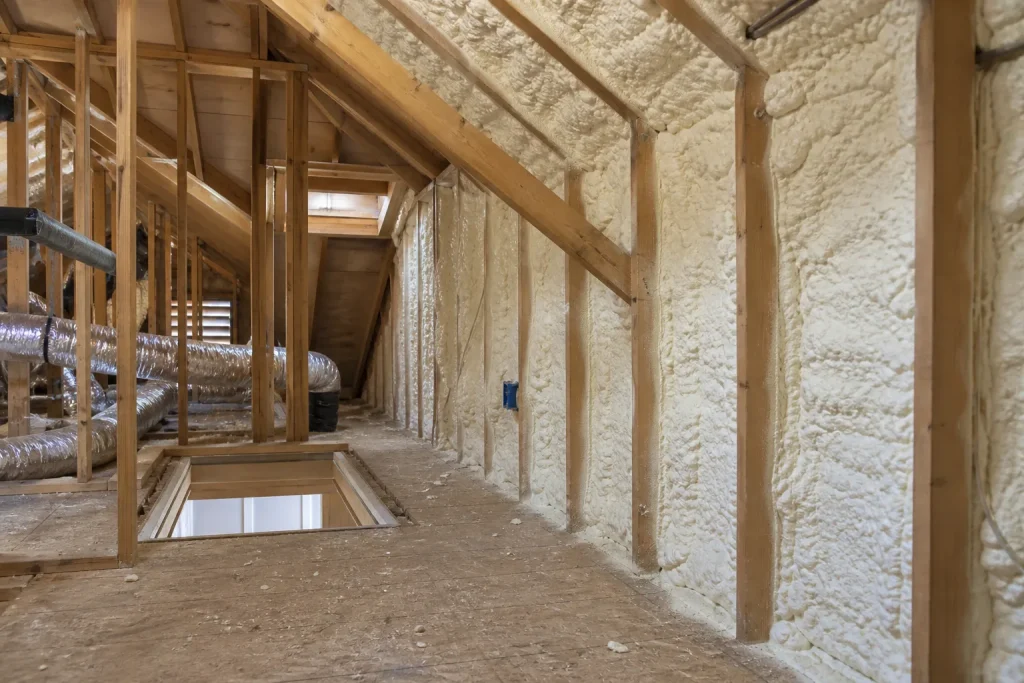
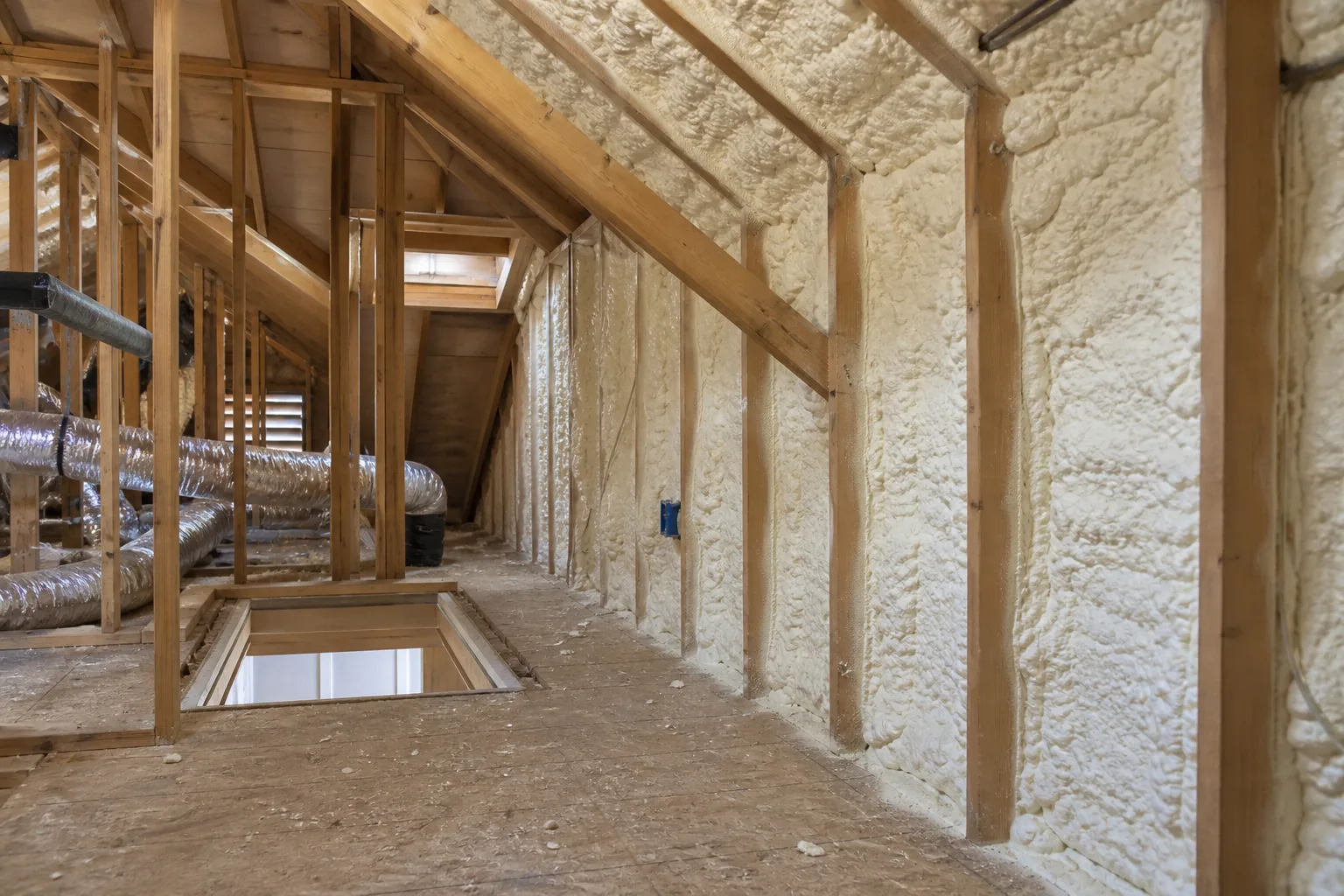
5 Mistakes to Avoid With Spray Foam Insulation
Spray foam applied to a substrate below 50°F surface temperature, which is common in Henderson garages and crawl spaces between November and February, will not bond or cure to its rated R-value, and adding more foam never fixes it. The same is true of four other errors: no vapor retarder in an unvented attic, passes sprayed too thick, unprotected HVAC and electrical, and no written yield log. All five are catchable before the foam cures. After that, each one becomes a remediation bill. If you’d rather not manage that yourself, call (844) 320-5338.
Mistake 1: Skipping the Substrate Temperature Check
The number that matters before the first pass is surface temperature, not air temperature. Both Icynene and BASF technical data sheets put the minimum substrate surface temperature at 50°F for standard spray foam systems. A Henderson garage wall in January can read 58°F at the air register and 44°F on the sheathing two feet away. The foam goes on cold, adheres poorly, and cures at a lower density than the rated spec.
What should happen before spraying starts: a non-contact infrared thermometer reading taken at multiple points on every substrate, in writing, with the crew’s initials next to each number. A compliant reading for a cold-weather spray shows every point at or above 50°F, ideally 55°F or higher for margin. If the sheathing reads 47°F, the substrate gets warmed or the job waits. In our experience working Henderson homes, most skipped temperature checks happen in garages and vented crawl spaces, not in conditioned attics.
Cold-substrate cure failure is invisible from the surface. The foam looks fine. It simply doesn’t perform, and the only way to prove it didn’t is to cut a core sample – which means removing and replacing the foam.
Mistake 2: No Vapor Retarder in an Unvented Henderson Attic
Henderson sits in climate zone 3B, and IRC R806.5 governs unvented attic assemblies. The code requires a vapor retarder on the interior side of the assembly, and for open-cell spray foam in zone 3B that means a Class II or better vapor retarder – typically 1 perm or less – plus a specific thickness of impermeable foam or an approved coating to keep interior moisture out of the foam. Open-cell foam alone, sprayed directly to the roof deck and left exposed, does not meet the requirement.
We’ve pulled open-cell out of an attic in Green Valley where it was sprayed to the deck with no retarder at all. Two summers later, the foam was damp to the touch on the underside. That’s a moisture problem the homeowner paid to create.
What to verify before the job:
- The written scope names the vapor retarder product and its perm rating, not just “vapor barrier.”
- The specified assembly matches IRC R806.5 for zone 3B, or the local AHJ has approved an alternate in writing.
- The installer can show the manufacturer’s technical bulletin covering the assembly as designed.
Closed-cell foam at 2 inches or more generally supplies the vapor retarder itself, which is why the open-cell versus closed-cell decision changes the whole spec.
Mistake 3: Spraying Passes Too Thick
Closed-cell foam is typically limited to a 2-inch maximum pass thickness by the manufacturer. That limit exists because spray foam cures exothermically – it generates heat as it reacts – and a thick single pass traps that heat in the middle of the lift. The result is charring at the core, delamination at the substrate, and an off-ratio cure that reads lower density than the datasheet promises.
The foam looks perfect from the outside. The failure is in the middle of a lift that, on a 6-inch closed-cell application, means three separate passes with a cool-down window between each. A crew trying to finish a Henderson attic in one afternoon has a strong incentive to stretch the passes. The written scope should name the maximum pass thickness and the wait time between passes.
Verification points:
- Pass thickness stated in the scope for each foam type, straight from the manufacturer’s data sheet.
- Applied thickness measured at four points after cure, not estimated by eye.
- Any lift thicker than spec flagged before cure, because thick lifts are still negotiable in the first hour and remediation after.
Mistake 4: No Masking of HVAC, Ducts, and Electrical
Spray foam chemically bonds to whatever it touches. It does not peel off the way most homeowners expect. When it lands on an air handler, flex duct, electrical panel, or outlet box, removal is a mechanical problem that can damage the equipment and, in the case of electrical, creates a code problem. Masking is not optional, and it should be in the scope.
A proper masking standard before any spray goes down:
- HVAC air handlers and furnaces wrapped in plastic sheeting taped at the seams.
- Flex duct and rigid duct runs bagged or shielded along their full length, not just at the ends.
- Electrical panels, junction boxes, and outlet boxes covered and labeled.
- Windows, doors, and finished surfaces in the spray zone taped off.
- Masking verified by the homeowner or a second crew member before the gun fires.
The five minutes of masking is the cheapest part of the job. Removing foam from an air handler in a Henderson attic is not.
Mistake 5: Accepting a Verbal R-Value Claim
An R-value spoken aloud is not a spec. It’s a claim. A compliant spray foam job record includes a written yield log with the documentation to prove what actually went in, and if the contractor can’t hand it over, the R-value is unverifiable.
What a compliant spray foam record should include:
- Drum lot numbers for every foam component used on the job.
- Mix ratio calibration log, dated and signed, from the day of application.
- Installer certification documentation for the crew on site.
- Applied thickness measurements at four points per assembly.
- Before-and-after blower-door results on applicable jobs – a pressurization reading that shows, in one number, how much air your envelope was losing.
Without these, you’re paying for a number no one can prove. And R-value alone doesn’t tell you the whole story, because spray foam’s performance depends on the air sealing underneath it. That’s why we treat Envelope Insulation Henderson home jobs as sealed first, then insulated – in that order – and refuse to blow or spray insulation over an unsealed assembly. Spray foam belongs in specific assemblies; if your attic doesn’t call for it, attic insulation in Henderson often delivers more for the money. For the whole-home view of where spray foam fits, spray foam insulation in Henderson covers the assemblies we recommend it for.
When to Call a Pro
Any of these five mistakes is a professional job to catch, because all five require reading a data sheet, measuring with an infrared thermometer, and documenting the result in writing. DIY spray foam kits don’t come with yield logs, calibration records, or a second set of eyes on pass thickness. Spray foam also involves isocyanate chemistry and full respiratory protection, which is one of several reasons we don’t recommend homeowner application in Henderson attics.
If your crawl space is part of the picture, crawl space encapsulation and vapor barrier in Henderson is where substrate temperature and vapor control get checked first. Spraying foam over a wet crawl space floor is a mistake we’d rather you never make.
Under The Haven Standard, every job starts with a written price before any work starts, includes a Documented Photo Record, and – on applicable jobs – ends with before-and-after blower-door readings. If you have a competing estimate, bring it and we’ll read it with you as a free second opinion.
The Bottom Line
The single most useful thing you can do before a spray foam job is ask for the substrate temperature readings, the vapor retarder spec for zone 3B, the maximum pass thickness, the masking plan, and the yield log – in writing, in advance. If a contractor can’t produce those five, the number on the estimate isn’t the whole price. These are the checkpoints that make the difference between spray foam that performs for twenty years and a remediation you pay for twice. Materials should be brand-name and traceable – we source Icynene, Knauf, and Rockwool for the assemblies that call for them, and we don’t lock customers into a single manufacturer.
If you’re in Henderson and want a documented spray foam job or just a second read on an estimate, Envelope Insulation Henderson offers free estimates – call (844) 320-5338. We answer live, 24/7, and every job arrives with the documentation described above from the first visit.
Frequently Asked Questions
Skipping the substrate temperature check. Spray foam applied below 50°F surface temperature won’t bond or cure to the rated R-value, and no amount of additional thickness fixes a cold cure. In Henderson garages and crawl spaces between November and February, surface temperature often runs below air temperature, which is why the check has to be done with a non-contact infrared thermometer at every substrate before the first pass.
Yes. IRC R806.5 governs unvented attic assemblies, and climate zone 3B – which covers Henderson – requires a Class II or better vapor retarder on the interior side, roughly 1 perm or less, plus the manufacturer’s approved assembly. Open-cell foam alone on the roof deck doesn’t satisfy the requirement. Call (844) 320-5338 if you want a second read on the assembly an installer is proposing.
Closed-cell spray foam is typically limited to a 2-inch maximum pass thickness by the manufacturer, and open-cell limits are set per manufacturer’s data sheet. Thicker single passes trap exothermic heat, causing charring, delamination, and off-ratio cure. A 6-inch closed-cell job is three passes with a wait between each, and the written scope should say so. Call (844) 320-5338 for a free estimate that names the pass thickness up front.
Drum lot numbers, mix ratio calibration log, installer certification, applied thickness measured at four points, and before-and-after blower-door results on applicable jobs. Without those, the R-value is a verbal claim. Ask for the record before the job starts, not after the foam cures. Call (844) 320-5338 to schedule a free estimate with the full documentation standard.
Written by the team at Envelope Insulation Henderson.
Need Insulation Help?
Call Envelope Insulation Henderson - licensed & insured, here with fast after-hours help in Henderson.
(844) 320-5338