
Demilec Attic Insulation in Henderson: A Homeowner’s Guide
A Henderson attic deck can pass 160°F in July. That single number decides more about a Demilec installation than any showroom sample or installer’s favorite product. Heat that extreme changes how open-cell foam cures, and it pushes the closed-cell versus open-cell decision into thermal engineering territory rather than a budget line. This guide lays out the deck temperatures, R-value targets, code requirements, and blower-door results that govern which Demilec product belongs in which Henderson attic. If you’d rather not sort through foam chemistry on a Saturday, call (844) 320-5338 and we’ll walk your attic with you.
What’s the difference between Demilec Heatlok HFO and Sealection 500?
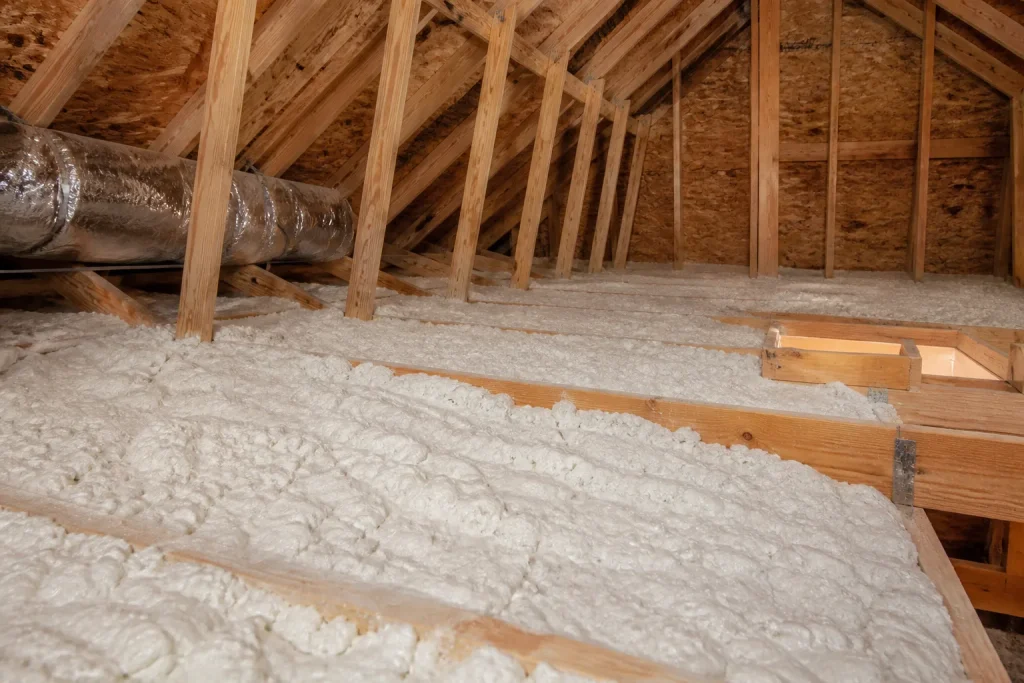
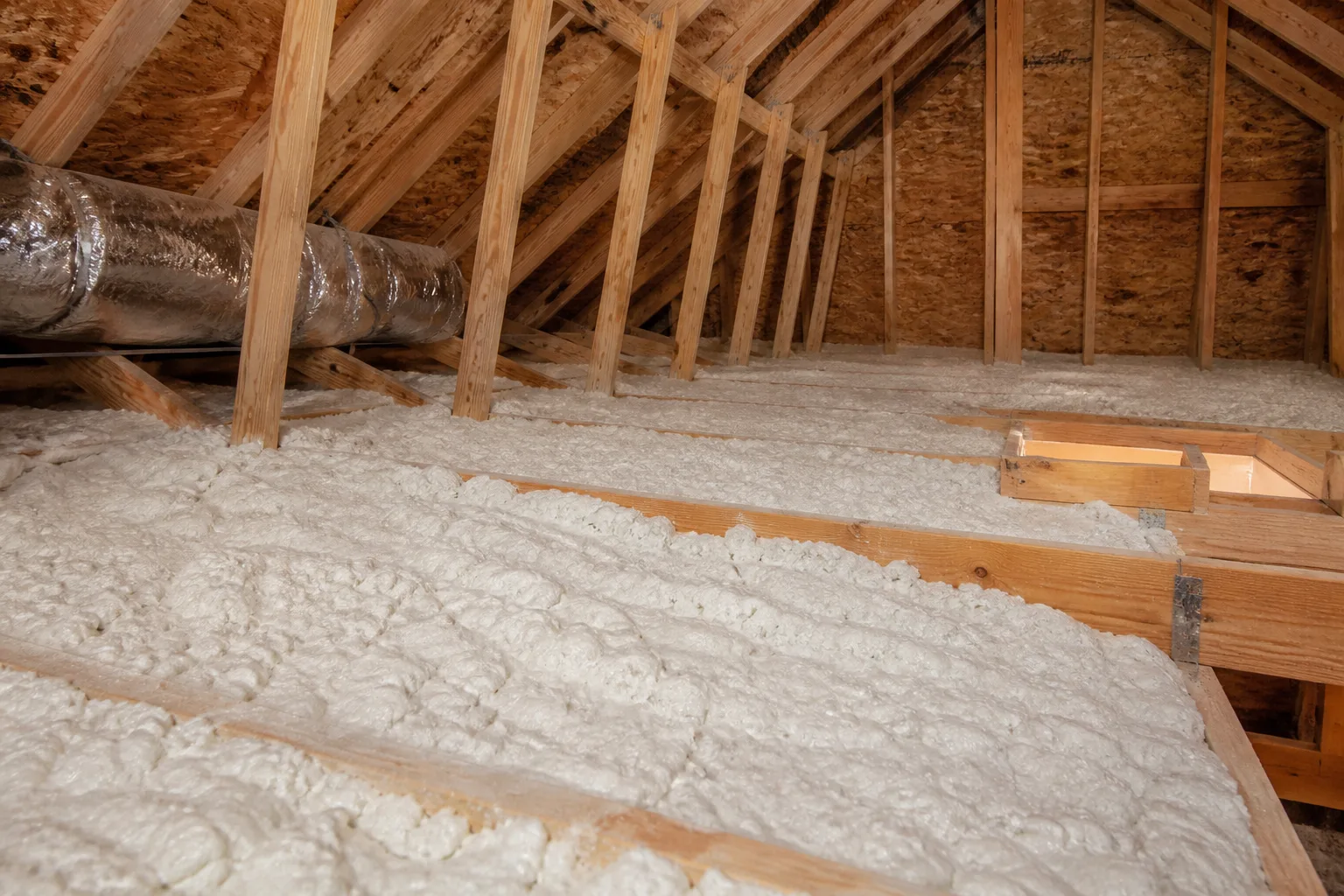
Heatlok HFO is Demilec’s closed-cell spray foam, and Sealection 500 is its open-cell product. The two are not interchangeable in a Henderson attic, and the gap between them comes down to density, R-value per inch, and how each behaves under heat.
- Heatlok HFO (closed-cell): roughly 2 lb/cu ft density, R-6 to R-7 per inch, acts as its own vapor retarder, and adds structural stiffness to the assembly. A 3-inch lift lands near R-20.
- Sealection 500 (open-cell): roughly 0.5 lb/cu ft, R-3.6 to R-3.8 per inch, vapor-permeable, and softer. Reaching R-20 takes about 5.5 inches.
In a Henderson attic, the choice hinges on the roof deck temperature during the cooling season. Closed-cell foam’s higher density holds up better on a deck that swings above 150°F, and it won’t let moisture migrate through the foam the way open-cell will. Open-cell earns its place on the underside of a roof deck where the assembly is designed to dry inward, or where the budget favors a thicker lift at a lower R-value per inch. We’ve measured deck temps at 158°F in an unvented attic off Warm Springs in August. That read alone often settles the argument.
The brand itself carries weight. Demilec foams are widely specified, and materials here are sourced from Demilec alongside Owens Corning and Johns Manville, so no single product line locks you in. For a closer look at how spray foam fits your home, see our Spray Foam Insulation in Henderson page.
Which Demilec foam belongs in your Henderson attic assembly?
Henderson sits in climate zone 3B, which is hot-dry. That designation matters because the foam specification depends on whether your attic is vented or unvented, and each assembly has its own rules.
Vented attic
If the attic is vented, the thermal boundary usually stays on the attic floor. Here you’re adding blown-in on top of an already-sealed floor, and Demilec spray foam may only come into play at penetrations or where the floor meets the knee wall. This is the cheaper path, and for many Henderson homes it’s the right one. It also means air sealing comes first, not the foam.
Unvented attic
An unvented attic moves the thermal boundary to the roof deck, and that’s where Demilec spray foam does its real work. Before any foam goes down, IRC Section R806.5 sets the conditions: the assembly must be sealed to the conditioned space, the foam must meet the minimum R-value for the climate zone, and the roof deck has to be rated for the exposure. Zone 3B carries its own R-value threshold, and spraying short of it fails inspection. We won’t start an unvented application until those code boxes are checked and documented.
If you’re weighing this against other approaches, our Attic Insulation in Henderson page covers the full ladder of options.
What blower-door CFM50 numbers should you expect before and after?
For a typical 2,000 sq ft Henderson home, a full Demilec attic air-seal-and-insulate job usually moves the blower-door reading from somewhere in the 3,500 to 5,500 CFM50 range down to roughly 1,800 to 2,800 CFM50. That’s the whole point of the work, and it’s measurable in a single figure.
A blower-door test is a pressurization reading that shows, in one number, how much air your building envelope is losing. CFM50 means cubic feet per minute at 50 pascals of pressure. Lower is better.
Here’s what we see on a 2,000 sq ft home in Henderson before we touch a thing:
- Before: around 4,000 to 5,000 CFM50 on a home with open top-plate bypasses and recessed can lights punching through the ceiling plane.
- After a proper seal-and-foam job: typically 40 to 55 percent lower, landing near 2,000 to 2,600 CFM50.
- ACH50 (air changes per hour at 50 pascals): a commonly cited target is 3.0 or below, and a well-executed Henderson job often lands there.
We publish the before-and-after on every applicable job so you can see the change you paid for. If a contractor won’t put a blower-door number on paper, ask why.
What goes into a written Demilec job record?
A Demilec job record should let a stranger reconstruct exactly what happened in your attic. If it doesn’t, you don’t have a record; you have a handshake.
- Board-feet installed for each product, along with the target and achieved thickness per lift.
- Yield logs from the foam rig, showing the actual expansion you paid for versus the manufacturer’s stated yield.
- Installer certification number for the tech who pulled the trigger, tied to the date of work.
- Pre- and post-install blower-door readings, in CFM50 and ACH50, on the same sheet.
- The written scope and written warranty you were handed before anyone lifted a tool.
We include a Documented Photo Record on every visit, not on request. That’s part of operating under The Haven Standard, which says you get the price, the scope, and the warranty in writing before work starts. Our technicians have up to 10 years of experience, and the certificate list travels with the job file so you can see who was in your attic and what their credentials were. If you want a second set of eyes on a competing quote, our Free Second Opinion on Any Written Estimate reads it with you line by line.
The one Demilec install error we see most in Henderson
Spraying Demilec over existing blown-in insulation without first sealing top-plate bypasses. It’s the most common mistake in Henderson attics, and it quietly erases most of what you paid for.
The bypasses are the gaps at the top plate where the wall meets the ceiling, the recessed can light housings, and the penetrations where plumbing and wiring pass through. Air moves through those openings whether or not there’s foam over the floor. A closed-cell lift over an unsealed floor traps the leakage under the foam, and the blower door barely moves. In our experience, that shortcut costs roughly 1.5 to 2.0 ACH50 against a properly sealed assembly. You paid for foam and got a lid on top of a leak.
That’s why we seal first, then insulate, in that order. Air sealing of top plates, can lights, and penetrations gets completed before any Demilec product goes down. It’s not an upsell; it’s the prerequisite. And it’s why the before-and-after blower-door number belongs on every job. If you suspect a past contractor skipped this step, our Envelope Insulation Henderson home page outlines how we assess and correct it.
If the foam sits over a damp crawl space or a floor without a vapor barrier, the moisture picture gets worse. Our Crawl Space Encapsulation & Vapor Barrier in Henderson page covers that side of the envelope.
When should you call a pro instead of watching a video?
Spray foam involves pressurized equipment, isocyanate chemistry, and a roof-deck decision that code inspectors will check. This is not a weekend project, and a misapplied unvented assembly can trap moisture and rot the deck from the inside. Call a pro when:
- You’re switching a vented attic to unvented and need R806.5 compliance documented.
- Your deck temps run above 150°F and you need a closed-cell specification.
- You have recessed can lights or plumbing penetrations that must be sealed first.
- You want a blower-door number before and after, and a written record to show for it.
We answer calls 24/7 with a live person, no voicemail loops. Under Haven Standard, you get a named technician and a text when they’re on the way.
Related services in Henderson: if you’re comparing materials or assemblies, see Attic Insulation in Henderson, Spray Foam Insulation in Henderson, and Crawl Space Encapsulation & Vapor Barrier in Henderson.
The Bottom Line
In Henderson, the Demilec question isn’t closed-cell versus open-cell in the abstract. It’s a matter of deck temperature, assembly type, and the code thresholds for zone 3B. Heatlok HFO earns the unvented roof-deck spec on a 160°F deck. Sealection 500 has its place where the assembly is designed to dry. And in both cases, air sealing comes first, because spraying foam over an unsealed floor is money left in the attic. Measure the deck, seal the bypasses, spray to the target R-value, and put the blower-door numbers on paper. Under The Haven Standard, we back all of it with the 365-Day Done Right Promise if something isn’t right.
If you’re in Henderson and need help, Envelope Insulation Henderson offers free estimates. Call (844) 320-5338.
Frequently Asked Questions
Yes. Demilec’s sprayed foams suit Henderson’s hot-dry attic conditions, provided the product is matched to the assembly: Heatlok HFO for unvented roof decks that run hot, Sealection 500 where the assembly is designed to dry inward. The real question is whether the installer measured your deck temperature and sealed the top-plate bypasses before spraying. Call (844) 320-5338 for an exact spec on your attic, and estimates are free.
For an unvented attic with a roof deck that exceeds roughly 150°F in summer, closed-cell (Heatlok HFO) is the usual choice because it holds R-value at heat and adds structural stiffness. Open-cell (Sealection 500) fits where the assembly needs to dry inward or the budget favors a thicker lift. The deck temperature decides it. Call (844) 320-5338 and we’ll take the reading before anyone quotes a product.
Not safely, and not without consequences. Spraying Demilec over unsealed existing blown-in traps top-plate bypasses under the foam, and the blower door barely moves, often costing 1.5 to 2.0 ACH50 against a properly sealed assembly. Air sealing happens first; insulation second. Call (844) 320-5338 for a free second opinion on any written quote that skips the sealing step.
A typical 2,000 sq ft Henderson home usually drops from about 4,000 to 5,000 CFM50 down to roughly 2,000 to 2,600 CFM50 after a full seal-and-foam job, a 40 to 55 percent reduction. We put the before-and-after numbers in writing on every applicable job. Call (844) 320-5338 for a free estimate that includes the blower-door report.
Written by the team at Envelope Insulation Henderson.
Need Insulation Help?
Call Envelope Insulation Henderson - licensed & insured, here with fast after-hours help in Henderson.
(844) 320-5338