
Icynene Attic Insulation in Henderson: A Homeowner’s Guide
Icynene open-cell foam hits about R-3.7 per inch and seals a leaky attic in a single pass, which is why it gets sold hard in Henderson. But here’s what the sales pitch tends to skip: that same foam runs 10 to 14 perms vapor-permeable, and in an unvented Henderson attic with an evaporative cooler pushing moisture around, that openness can drive vapor the wrong way. This guide covers when Icynene is genuinely the right call here and when a different assembly wins.
If you’d rather have a trained eye look at your attic than work through the decision alone, call (844) 320-5338 and we’ll set up a free estimate.
Open-Cell Icynene vs. Closed-Cell: Which Belongs in a Henderson Attic?
The short answer: open-cell Icynene is a fit for the attic floor and for specific interior applications, while closed-cell belongs against a roof deck where you need a vapor barrier and higher R-value per inch. Henderson sits in climate zone 3B, a hot-dry zone with a real monsoon season, and that mix shapes which foam goes where.
The trade-offs come down to three numbers:
- R-value per inch: open-cell Icynene runs about R-3.7 per inch; closed-cell runs about R-6.5 per inch. Reaching R-38 on a roof deck with open-cell means roughly 10 inches of foam. Closed-cell gets there in about 6.
- Vapor permeability: open-cell sits around 10 to 14 perms (a perm measures how much water vapor moves through a material). Closed-cell is a vapor barrier at well under 1 perm.
- Air sealing: both foams expand into gaps and form a continuous air barrier, which is the real performance gain over batts.
For a vented attic floor in Henderson, open-cell Icynene or blown fiberglass from Owens Corning or Johns Manville both make sense, provided the air sealing underneath is done first. For an unvented roof deck, closed-cell is usually the more defensible choice because it blocks the inward vapor drive that open-cell permits. If you want the full comparison of attic approaches, our page on attic insulation in Henderson walks through each option.
The Unvented Attic Assembly and Why It Needs a Cooling Check First
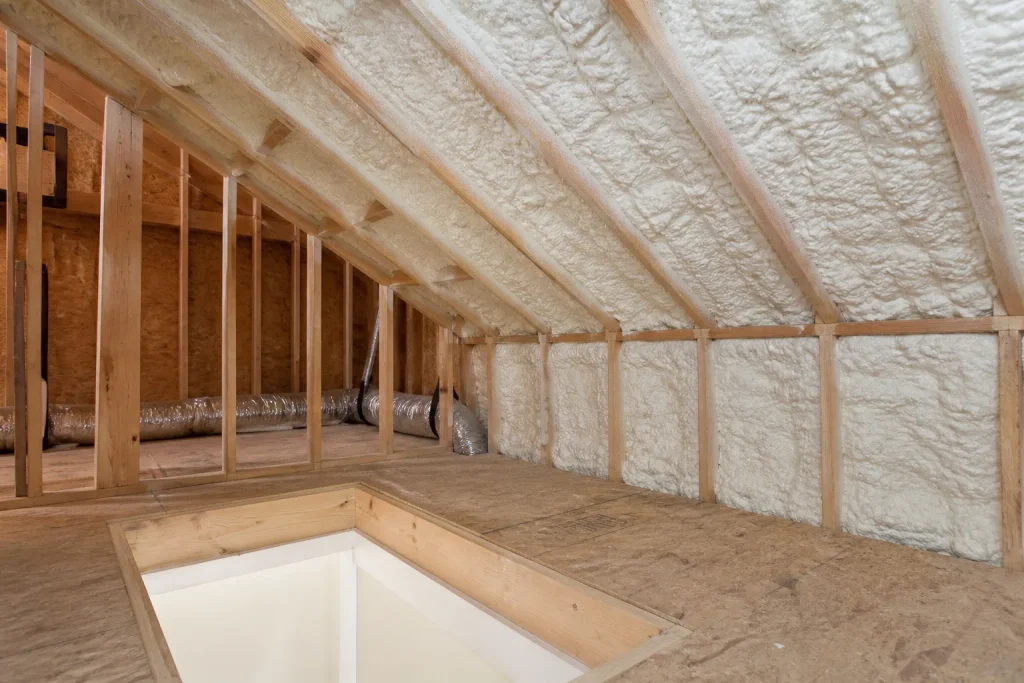
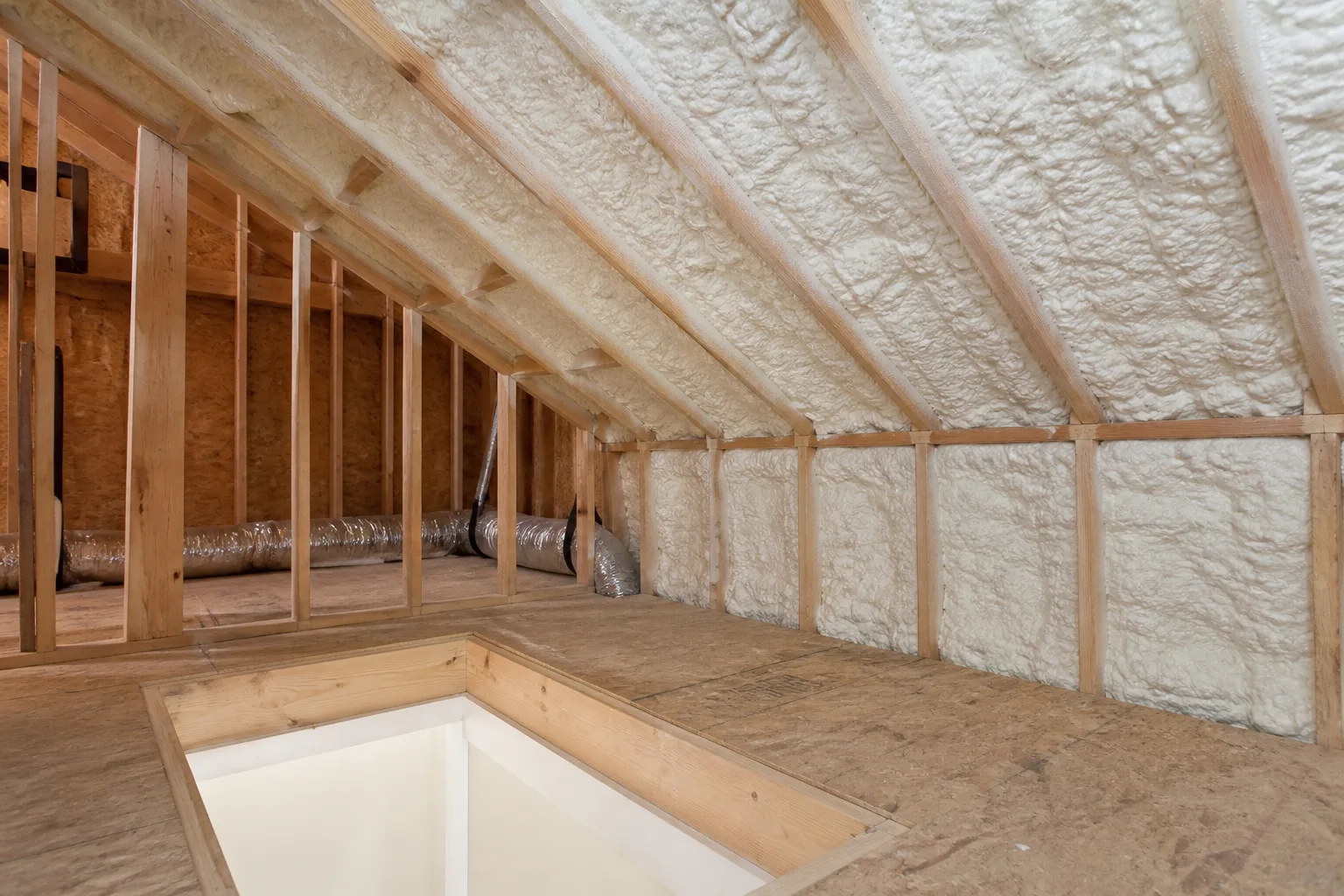
An unvented attic is one where foam goes on the underside of the roof deck instead of on the attic floor. This pulls the attic inside the conditioned envelope, which is great for ductwork and equipment up there, but it changes how the assembly handles moisture. Before anyone specifies Icynene for this, a mechanical cooling confirmation matters.
Here’s the reasoning. In an unvented assembly, the roof deck becomes part of the building envelope. If the home relies on an evaporative cooler, that cooler introduces moisture-laden air into the living space. With open-cell foam at 10 to 14 perms on the roof deck, some of that vapor can migrate toward the cooler nighttime deck surface and condense. Closed-cell or a properly detailed vapor strategy prevents it. Confirming that the home has adequate mechanical cooling (and that interior humidity stays in a reasonable band) is the check that tells us whether open-cell Icynene is safe on that deck or whether we steer toward closed-cell.
We’ve walked attics in Green Valley where a previous installer foamed an unvented deck with open-cell and skipped that verification entirely. The foam looked fine from below. The deck sheathing above it told a different story after two summers.
What the Icynene Installation Actually Produces
A spray-foam job done right produces a continuous air barrier, not a pile of insulation. That distinction is the whole point in Henderson, where summer attic temperatures routinely push past 140°F and every unsealed penetration leaks conditioned air you already paid to cool.
The installation sequence matters:
- Air sealing of top plates, can lights, plumbing and electrical penetrations is completed first, then verified.
- Foam is applied in lifts (thin passes) to the specified depth, each lift allowed to cure before the next.
- Installed thickness is measured at multiple points across the field, not just one spot.
- A blower-door test, a pressurization reading that shows in one number how much air the envelope is leaking, is taken after the work so the change is documented.
That last step is what separates a measured result from a claim. We publish before-and-after blower-door readings on applicable jobs because a single CFM50 figure tells you exactly what you bought. On a recent Henderson job, the reading dropped from 4,300 CFM50 before sealing to 2,050 after. That’s the number a homeowner can point to.
Two Henderson Scenarios Where Icynene Is the Defensible Choice
Open-cell Icynene isn’t the wrong answer everywhere. In our experience there are two specific Henderson situations where it’s the sensible specification, and both come down to geometry and ductwork.
1. Existing ductwork in the attic that needs to come inside the thermal envelope. Plenty of older Henderson homes have supply ducts running through a vented attic, losing cold air before it reaches a room. Foaming the roof deck with open-cell Icynene brings those ducts inside the conditioned space and stops the loss. Closed-cell works here too, but open-cell is often the more cost-effective option when the vapor path is managed.
2. Cathedral ceiling assemblies with no room for ventilation baffles. A vaulted ceiling with no gap between the rafters and the roof deck has nowhere for a vent channel. Foam applied directly to the deck is often the only workable assembly, and open-cell handles the irregular framing well.
Outside those two cases, on a standard vented attic floor, the better move is almost always air sealing plus a high-quality blown product from GreenFiber or Knauf, which costs less per R and performs well when the leaks underneath are closed.
The Documentation Package You Should Receive on a Spray-Foam Job
A spray-foam job without documentation is a claim, not a result. Here’s what a complete package should include when the work is finished in Henderson, and what we hand over at the close of every applicable job.
- Installed thickness measurements taken at multiple points across the field and recorded in writing.
- Blower-door pre- and post-readings in CFM50 so the performance change is a number, not a feeling.
- The cured foam manufacturer data sheet showing the R-value of Icynene at the depth actually installed. Be wary of anyone who quotes R-value on a product spec without the depth to back it.
- The written scope and written warranty delivered before any work starts. At Envelope, that’s Haven Standard Clause 1: flat price, written scope, written warranty, no exceptions.
If you’re comparing bids, bring us the competing estimate and we’ll read it with you. Line-item scope matters more than a bottom-line number.
When to call a pro: spray foam is not a DIY product. The two-part chemistry, the temperature and moisture conditions at application, and the off-gassing during cure all require a trained, equipped installer. This is a system that has to be specified for your assembly, not a product you buy off a shelf.
Related services in Henderson: if your attic needs air sealing before insulation, or if you’re dealing with moisture in the crawl space, see our pages on crawl space encapsulation & vapor barrier in Henderson and spray foam insulation in Henderson.
The Bottom Line
Icynene open-cell foam is a strong performer in the right assembly and a liability in the wrong one. In Henderson’s climate zone 3B, it belongs on a vented attic floor or in the two specific scenarios above (attic ductwork and baffle-less cathedral ceilings). On an unvented roof deck, closed-cell usually wins because it blocks inward vapor drive, and a mechanical cooling check should precede any open-cell specification.
Whichever route you take, the two things that actually determine performance are air sealing before insulation and documented proof after. Both are non-negotiable here. If you’re in Henderson and want a written price and a documented result, call (844) 320-5338 for a free estimate. You can also start at our Envelope Insulation Henderson home page.
Frequently Asked Questions
It’s the best choice in specific cases, not every case. Open-cell Icynene excels on a vented attic floor and in attic-duct and cathedral-ceiling scenarios, but closed-cell usually wins against an unvented roof deck because Icynene’s 10 to 14 perm vapor permeability allows inward vapor drive, especially with an evaporative cooler running.
Sometimes, but only after a mechanical cooling confirmation. Because open-cell foam is vapor-permeable, an unvented deck in a hot-dry climate needs the home’s interior humidity managed before open-cell is specified. If that check can’t be verified, closed-cell is the safer assembly.
Open-cell foam typically runs higher per square foot than blown fiberglass because of the labor and chemistry involved, and the exact figure depends on the assembly, depth, and square footage. We don’t publish a single number in this post because the range across Henderson homes is wide. The right move is a written price before any work starts, which is what we provide on every estimate. Call (844) 320-5338 for a free estimate and a written scope.
You should receive installed thickness measurements at multiple points, blower-door pre- and post-readings in CFM50, and the cured foam manufacturer data sheet showing R-value at the installed depth. A written scope and written warranty should be in hand before any work begins.
Written by the team at Envelope Insulation Henderson.
Need Insulation Help?
Call Envelope Insulation Henderson - licensed & insured, here with fast after-hours help in Henderson.
(844) 320-5338