
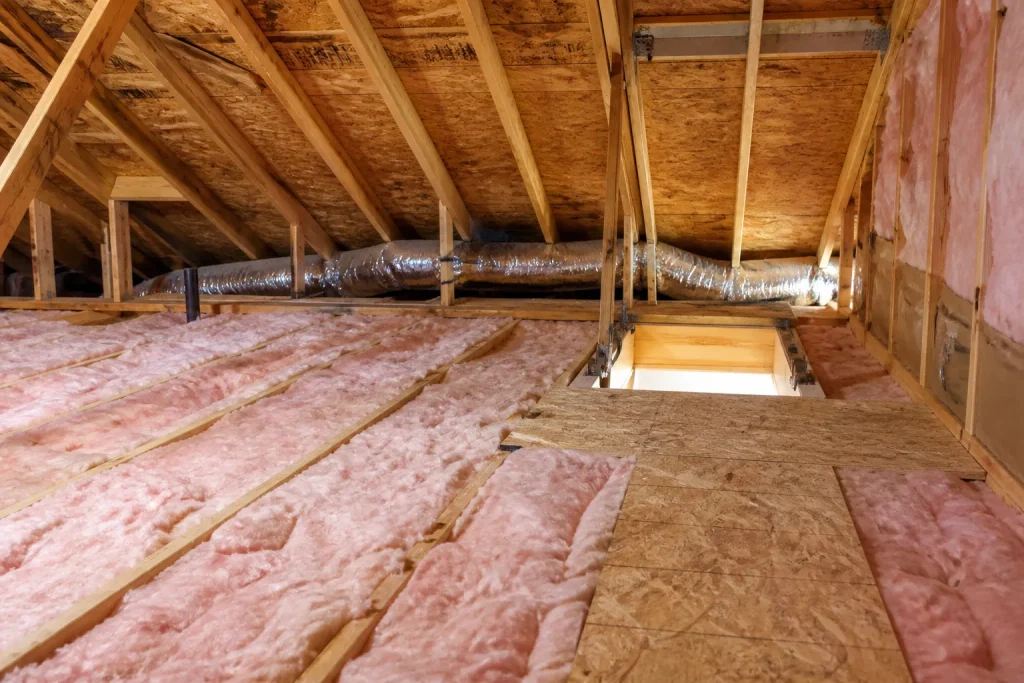
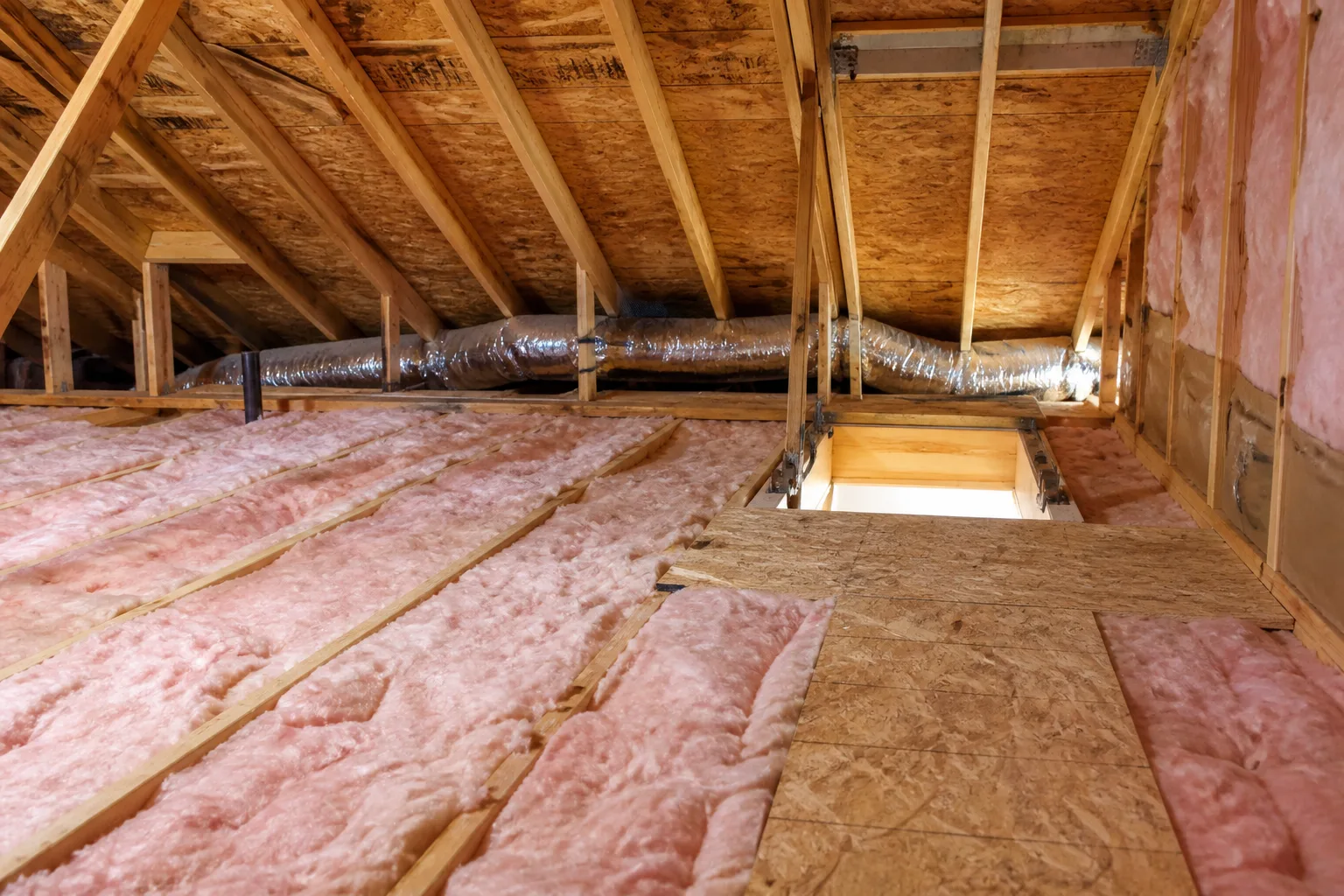
Owens Corning Attic Insulation in Henderson: A Homeowner’s Guide
Owens Corning’s EcoTouch batt is rated R-38 at a 75°F mean temperature. In the attic assemblies we open across Henderson, summer deck temperatures run past 120°F and routinely hit 160°F, and at those temperatures fiberglass loses roughly 15-20% of its effective R-value. The label doesn’t say that, and most bids you’ll get in Henderson don’t account for it either. What follows is what that thermal drift actually means for the R-value you’re paying for, and which installation practices make up the difference.
If you’d rather have a technician read your own attic than parse a spec sheet, call (844) 320-5338 for a free estimate. No work starts without a written price.
Why an R-38 label doesn’t mean R-38 in a Henderson attic
R-value is measured in a lab, under a fixed set of conditions. The standard is ASTM C518, which tests a material between two plates held at a 75°F mean temperature with a specific temperature difference across it. Those are the numbers on the Owens Corning bag. Your attic is not a lab plate.
On an August afternoon in Henderson, the underside of the roof deck absorbs radiant heat and the air in the assembly climbs well above outdoor temperature. Insulation manufacturers publish derating curves for exactly this reason. Fiberglass conductivity rises as mean temperature rises, so the same thickness of Owens Corning loosefill that delivers R-38 at 75°F delivers meaningfully less at the 120°F-plus mean temperatures we measure inside Henderson roof assemblies in summer. The 15-20% range is the figure that shows up repeatedly in filed, third-party testing of fiberglass at high mean temperatures, and it matches what the blower door and thermal camera tell us on real Henderson homes.
This isn’t an Owens Corning problem. Johns Manville, Knauf, and Rockwool all face the same physics because they all sell fiberglass or mineral wool tested the same way. It’s a product-category fact, and it means the R-value you’re buying is a moving number that depends on how hot the assembly runs and how well the installation was done.
- What stays constant: the labeled R-value at 75°F.
- What drifts: effective R-value as the attic mean temperature climbs past 100°F.
- What compensates: higher installed R-value, better air sealing, and correct depth – in that order.
What the thermal drift means for the R-value you’re actually buying
Here’s the practical translation. If your Henderson home was insulated to a nominal R-38 and the assembly loses 18% at summer mean temperatures, your attic is performing close to R-31 at the hottest part of the day – right when your air conditioner is working hardest and the heat gain matters most. That gap is why two Henderson houses with the same labeled R-value can have noticeably different summer power bills.
There are three ways to close the gap, and a good bid addresses all three:
- Insulate to a higher nominal R-value than the code minimum. The 2024 energy code for climate zone 3B, which covers Henderson, calls for roughly R-38 to R-49 in attics. Going to the top of that range or slightly above gives you margin for the derating.
- Stop air first. The hottest air in your attic is also the air that leaks through top plates, can lights, and plumbing penetrations. Sealing those before you add insulation is what makes the derating matter less, because you’re reducing the heat load rather than just slowing it.
- Verify depth, not bag count. A contractor who installs to a labeled depth marker with documented measurements is delivering a known R-value. A contractor who eyeballs it is delivering a guess.
That’s the whole argument for treating air sealing as a prerequisite rather than an upsell. It’s why we won’t blow Owens Corning loosefill over an unsealed attic floor in Henderson – sealing comes first, every time, and it’s written into the scope before anyone lifts a tool.
Installing Owens Corning blown-in the right way, step by step
Owens Corning’s blown-in products – AttiCat and the loosefill lines – are good material installed well. Installed carelessly, they underperform any product on the market. Here’s the sequence a compliant Henderson installation follows, and what you should see in the documentation afterward.
- 1
Air seal every top-plate bypass first. That means foaming the gaps where the wall top plates meet the ceiling drywall, sealing around every recessed can light with a rated cover, and closing plumbing and electrical penetrations. This step is done before a single bag of insulation goes in.
- 2
Install labeled depth markers. The installer places rulers at intervals across the attic floor so depth is measured, not assumed. Owens Corning publishes a coverage chart that ties bags-per-1,000-square-feet to a specific installed depth and R-value – and that ratio only holds if the machine is calibrated and the material is fluffed correctly.
- 3
Document bags per 1,000 square feet against the coverage chart. A 1,500-square-foot Henderson attic at a target of R-49 needs a known number of bags. That number should appear on your paperwork, not just in the installer’s head.
- 4
Verify final depth with a measurement. Depth markers get photographed. The photo goes in your record.
- 5
Run a post-installation blower-door test. This is the step most bids skip. A blower-door test – a pressurization reading that shows, in one number, how much air your building envelope is losing – is how you prove the air sealing actually happened versus just got billed for.
Owens Corning’s coverage charts are public and worth requesting from any contractor bidding your Henderson job. If they can’t tell you how many bags per 1,000 square feet they plan to install, they’re planning to guess. Browse our attic insulation services in Henderson for the full sequence we follow.
The vapor retarder question: when to specify unfaced Owens Corning batts in Henderson
This is the detail that trips up a lot of Henderson homeowners comparing bids. Owens Corning faced batts come with kraft paper on one side, and kraft facing acts as a vapor retarder. In cold climates, that’s exactly what you want – it slows moisture from the warm interior side from reaching a cold condensing surface. Henderson is climate zone 3B: hot and dry, with a cooling-dominated load and very little winter moisture drive.
In climate zone 3B, kraft facing on attic batts is frequently unnecessary. Worse, in the rare event of a roof leak or a condensation event from a poorly vented bath fan, a faced batt can trap moisture against the deck or the ceiling plane rather than letting the assembly dry. Trapped moisture in an attic in Henderson means mold, and it’s a repair you don’t want to fund twice.
- Specify unfaced when: you’re installing on an attic floor over an already-sealed ceiling plane in climate zone 3B, or adding a second layer on top of existing unfaced insulation.
- Specify faced when: the batt is going into a wall cavity where the local code and assembly design call for a class-II or III vapor retarder, and the assembly allows it to dry to one side.
- Ask your contractor which one they’re specifying and why. If the answer is “whatever we had on the truck,” get a second opinion.
Blown-in Owens Corning loosefill sidesteps the question entirely because it has no facing. For a lot of Henderson attics, that makes it the simpler and more forgiving choice.
What blower-door improvement should you expect in a Henderson home?
This is the number that tells you whether the air sealing was real. On a properly air-sealed Henderson attic floor, we typically see a blower-door reading drop by roughly 15-30% between the pre-work and post-work test, depending on how leaky the house started. That’s the coarse range across the homes we’ve tested. Homes with unsealed can lights and obvious top-plate bypasses often land at the higher end.
Compare that to an Owens Corning blown-in job installed over an unsealed attic floor. The blower door barely moves, because the air bypasses the insulation through the same gaps it always used. The house looks insulated. The insulation is doing less than half its job.
Here’s what the two scenarios look like side by side:
- Sealed first, then Owens Corning blown-in: measurable drop in CFM50, real reduction in heat gain, and a number you can put against next summer’s utility bill.
- Blown-in over unsealed floor: insulation installed, label R-value delivered, CFM50 essentially unchanged. We’ve pulled outsulation from a garage-turned-living-space over in Green Valley where the previous owner had paid for R-49 loosefill over a completely unsealed top plate. The blower door didn’t budge after that first job, and the homeowner had the receipts to prove it.
Every applicable job we run in Henderson publishes before-and-after blower-door readings. That’s the record that separates a real envelope improvement from a bag count on an invoice.
What a compliant Owens Corning job record looks like
The best insurance against a poorly installed Owens Corning job is documentation you keep. Here’s what should land in your hands when the crew leaves, in Henderson or anywhere else.
- Product batch numbers. So there’s no question about which run of material was installed.
- Square footage of attic floor covered. Not the house square footage – the actual insulated area.
- Installed depth measurements. With photos at the labeled depth markers.
- Bags per 1,000 square feet, reconciled to the Owens Corning coverage chart. This is the only way to confirm the delivered R-value.
- Pre- and post-installation blower-door readings. CFM50 before and after, together on one report.
- Written scope and written warranty, delivered before work started. Not handed to you at the end.
Under Haven Standard Clause 1 – have it in writing – that paperwork is generated before anyone starts. It’s how we’ve handled more than 9,000 homes since 2016, and it’s what the 365-Day Done Right Promise is built on: if it’s not done right, we make it right.
When to call a pro
Attic insulation looks DIY-friendly and mostly isn’t. Climbing through a Henderson attic in July means working around energized wiring, recessed can fixtures with hot bulbs, and gas flue pipes – and loosefill installation requires a calibrated blower to hit the correct density, which is the difference between R-49 and a fluffy mess. The air sealing step has its own risks: foaming around a gas flue or an unrated can light can be a genuine safety issue if you don’t know what you’re looking at. We recommend a trained technician for anything beyond surface inspection. If you want the full picture before you commit, our Henderson insulation services page lays out the whole envelope.
Related services in Henderson
If your attic problem extends past the ceiling plane, we also handle crawl space encapsulation and vapor barriers in Henderson and spray foam insulation in Henderson for assemblies where fiberglass can’t deliver the air-sealing performance you need.
The Bottom Line
Owens Corning makes good fiberglass insulation. The label R-value is tested at 75°F, and your Henderson attic lives well above that, which is why effective R-value drifts down in the heat and why installation method matters more than the number on the bag. Three things determine what you actually get: air sealing before any insulation goes in, documented depth and bag counts against the coverage chart, and a post-installation blower-door reading that proves the seal was done.
If you’re in Henderson and want to know what your attic is actually delivering, Envelope Insulation Henderson offers free estimates – call (844) 320-5338. Bring us a competing Owens Corning bid and we’ll read it through with you; a second opinion is free, and that’s part of the Haven Standard too.
Frequently Asked Questions
Yes. Owens Corning fiberglass insulation is tested per ASTM C518 at a 75°F mean temperature, and at the 120°F-plus mean temperatures measured inside Henderson attic assemblies in summer, effective R-value drops by roughly 15-20%. That’s a property of fiberglass generally, not a defect in Owens Corning – Johns Manville, Knauf, and Rockwool all show the same drift because the physics is the same. The best way to compensate is to insulate above the code minimum and air seal the attic floor first. Call (844) 320-5338 for an exact quote for your Henderson home – estimates are free.
In most Henderson attic applications, unfaced is the better choice. Henderson sits in climate zone 3B – hot and dry, cooling-dominated – so the kraft vapor retarder on faced batts is often unnecessary and, in the rare event of a roof leak, can trap moisture against the assembly. Specify unfaced for attic floor installations over a sealed ceiling plane, and faced only where code and assembly design call for a vapor retarder in a wall cavity. Not sure which your home needs? Call (844) 320-5338 and we’ll walk through your specific attic.
It depends on your square footage and target R-value. Owens Corning publishes a coverage chart that ties bags-per-1,000-square-feet to a specific installed depth and R-value, and a compliant installation reconciles the two: square footage covered, installed depth measured, and bag count against the chart. A 1,500-square-foot attic targeting R-49 needs a known number of bags, and that number belongs on your written scope. If a contractor can’t tell you their bag count per 1,000 square feet, ask why. Call (844) 320-5338 for a written price on your Henderson attic – the number comes before any work starts.
On a properly air-sealed Henderson attic floor, a blower-door test typically shows a 15-30% drop in CFM50 between the pre-work and post-work readings. On an unsealed attic floor with insulation blown over the top, the blower-door reading barely moves, because air bypasses the insulation through the same gaps as before. That’s why we don’t install Owens Corning blown-in over an unsealed floor in Henderson, and why every applicable job includes before-and-after blower-door numbers in the record. Call (844) 320-5338 to schedule a free estimate and a baseline blower-door reading.
Written by the team at Envelope Insulation Henderson.
Need Insulation Help?
Call Envelope Insulation Henderson - licensed & insured, here with fast after-hours help in Henderson.
(844) 320-5338