
Last updated November 17, 2026
DIY vs Professional Insulation: The Henderson Homeowner’s Decision Guide
You can install R-38 blown fiberglass in a Henderson attic over a single weekend, get the depth exactly right, and watch your utility bill not move at all. That’s not a failure of effort. It’s what happens when insulation goes down over an air barrier with gaps in it. The insulation performs its rated job and the house still leaks conditioned air through every top plate, can light, and wire penetration in the ceiling plane. The only way to know whether that happened is a blower-door test, and the equipment to run one costs about $3,500 to own. This guide walks through which insulation scopes are genuinely DIY-appropriate in Henderson, which ones create risk you can’t verify, and how to decide for your specific house.
Quick Answer
DIY insulation makes sense only when the scope has no bearing on your home’s air barrier and the result can be checked with a tape measure and a depth gauge. Anything that touches the air barrier itself, involves spray foam, or sits in an attic that hasn’t had a documented blower-door test in the past five years belongs with a professional. In Henderson, the deciding factor is rarely skill. It’s whether the work needs a pressurization reading to prove it worked.
Table of Contents
- Why a Blower Door Changes the DIY Question
- Scopes Where DIY Is Genuinely Appropriate
- Scopes Where DIY Creates Unverifiable Risk
- The Rental-Equipment Reality in Henderson
- Nevada C-2 Licensing and What It Means for Homeowners
- The Decision Matrix: Four Factors That Point You One Way
- Henderson’s Climate and Why It Punishes Air Leaks
Why a Blower Door Changes the DIY Question
A blower-door test is a pressurization measurement. A calibrated fan mounts in an exterior doorway, pulls the house to a set pressure difference (usually 50 Pascals), and reports the airflow required to hold that pressure in cubic feet per minute, or CFM50. That single number tells you how leaky your building envelope is. It’s the difference between “we added insulation” and “we reduced air loss from 4,200 CFM50 to 2,100 CFM50.”
Insulation and air sealing are two different jobs. Fiberglass and mineral wool resist conductive heat flow. They do not stop air movement. If your attic floor has a continuous air barrier underneath the insulation, adding depth works the way the label promises. If it doesn’t, you’re insulating a sieve. The Henderson homes we see most often with this problem were built between 1995 and 2010, when ceiling penetrations were routinely left unsealed and can lights were installed without airtight housings.
Here’s the part that makes DIY genuinely tricky: you cannot feel this problem. An attic with a 15% air-barrier gap and R-38 insulation feels identical to a properly sealed attic with the same R-value when you stand in it. Your hand on the drywall won’t tell you. A thermal camera might catch a hot spot, but it won’t quantify the leak. Only the blower door does that, and that’s the piece of equipment almost no homeowner owns.
Scopes Where DIY Is Genuinely Appropriate
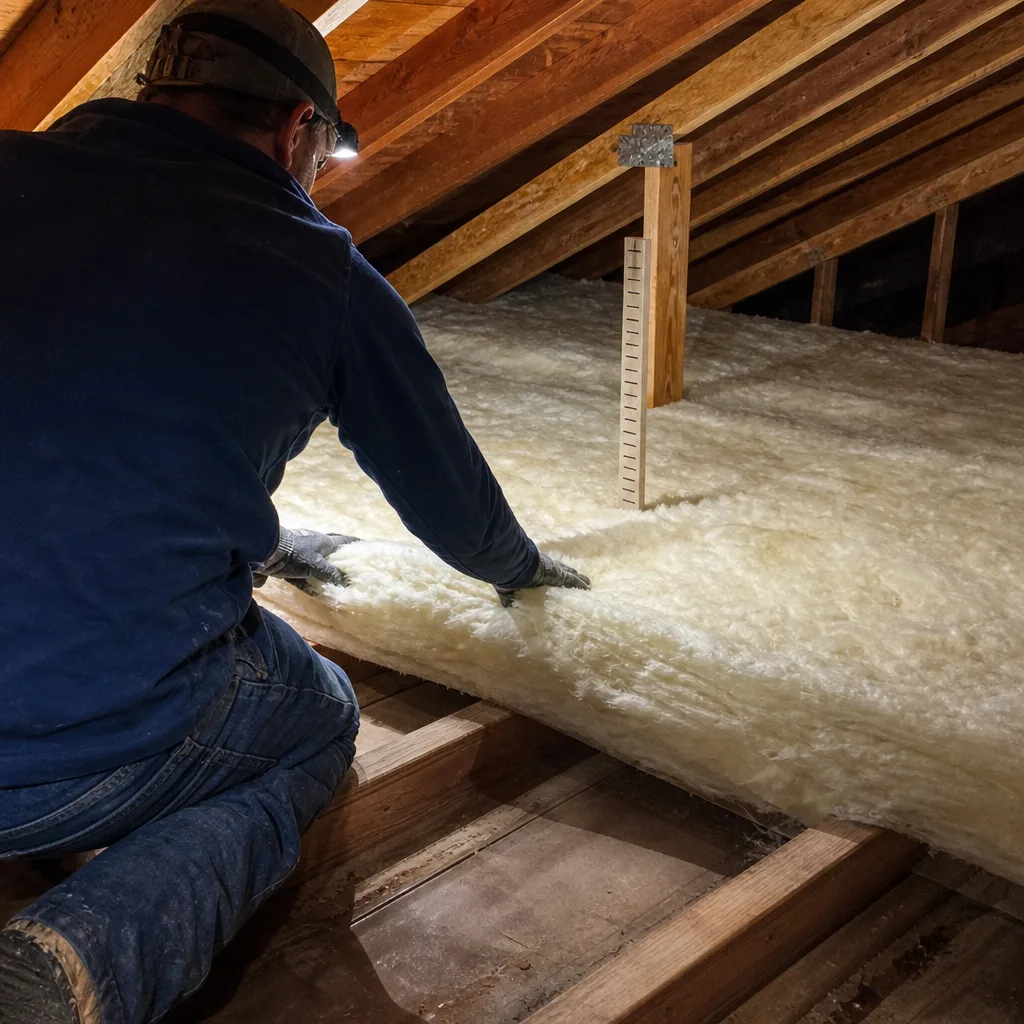
Some insulation work is straightforward and verifiable without instrumentation. These are the scopes where doing it yourself is a reasonable call, provided you understand exactly what you’re doing and what you’re not.
- Adding depth to an existing, documented air-sealed attic floor. If you have a written record showing a blower-door test after the air barrier was sealed, and the current insulation has settled below its rated depth, topping it up is a measurement job. You need a depth gauge, the right R-value per inch, and a clear understanding of what you’re covering. Use unfaced material if you’re going over existing batts.
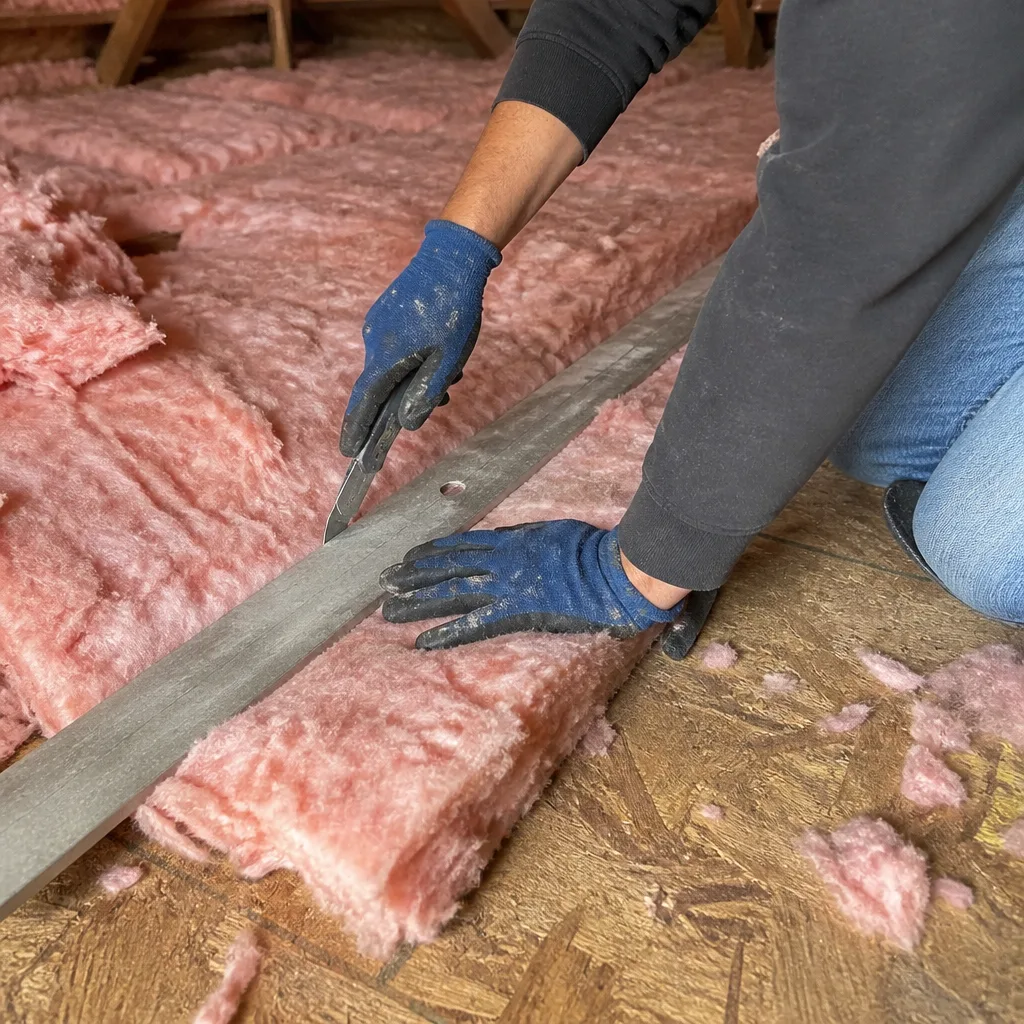
- Replacing a single damaged batt in an interior wall cavity. A batt that got wet during a plumbing repair or torn during remodeling can be swapped out with basic tools. Interior walls matter less for envelope performance, and the cavity is accessible and visible.
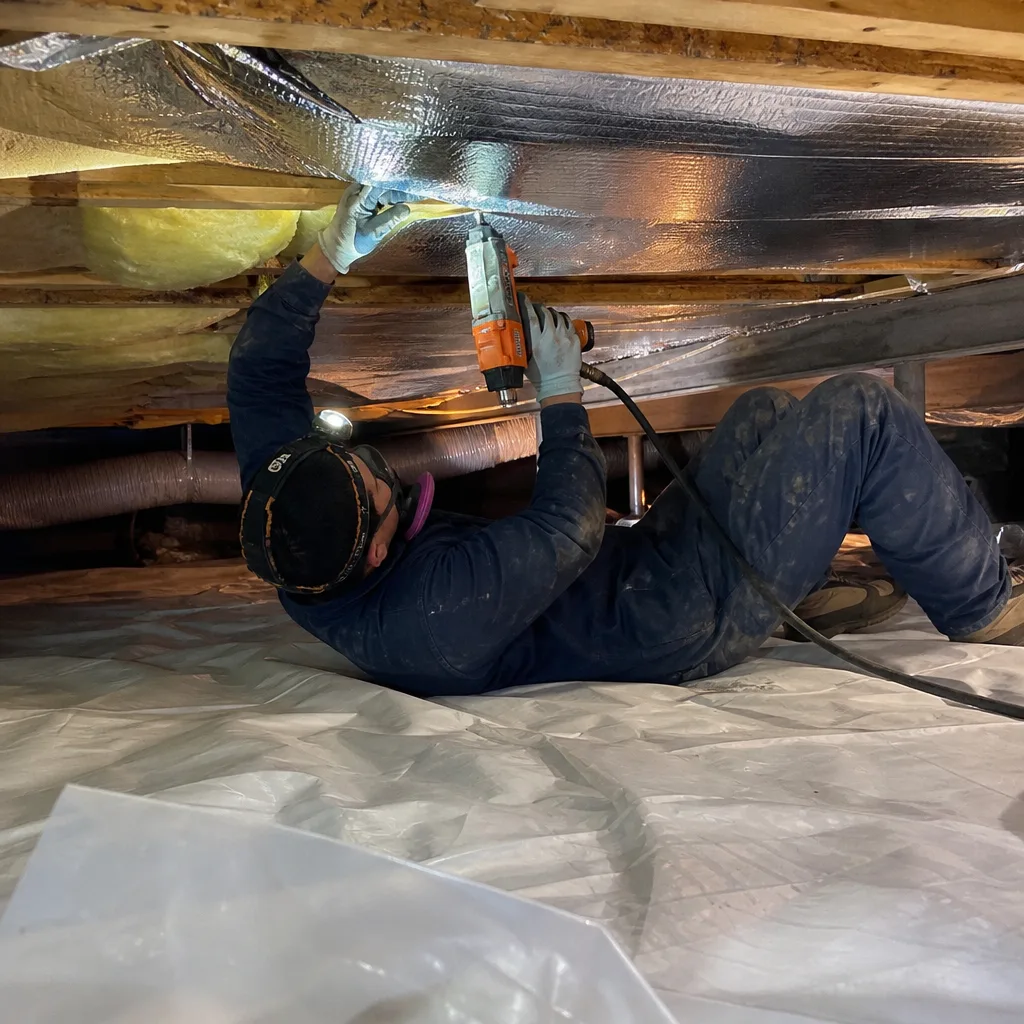
- Installing rigid foam board on an accessible crawl-space wall. If your crawl space is tall enough to work in and the wall is clean, cutting and fitting foil-faced polyiso or EPS and sealing the seams with foil tape is within reach. Keep in mind Henderson’s summer ground temperatures and the vapor direction before you commit; rigid foam goes on the warm side.
None of those scopes touch the air barrier. That’s the line. The moment a task requires sealing a penetration, foaming a rim joist, or applying spray foam, you’ve crossed into work that changes the envelope, and the envelope is where verification becomes mandatory.
Scopes Where DIY Creates Unverifiable Risk
The air barrier is the continuous plane that separates conditioned from unconditioned space. In a typical Henderson attic, that plane runs along the top plates of the exterior walls, around every wire and pipe penetration, around can lights and bath fans, and across the rim joist at the perimeter. Sealing it is the work that actually reduces air loss. It’s also the work that’s hardest to verify without a blower door.
- Top-plate sealing. The joint where the wall framing meets the ceiling drywall is one of the largest cumulative leak paths in any house. Sealing it means working at the perimeter of the attic where you’re compressed and often in tight clearance. Miss a section and you won’t know.
- Penetration sealing. Every electrical wire, plumbing vent, and exhaust duct that passes through the ceiling needs a gasketed or foamed seal. In a 2,000-square-foot house, that can be 60 to 100 individual penetrations. One missed wire box is a leak path.
- Rim joist foam. Open-cell or closed-cell spray foam along the band joist closes a major leak channel, but it requires a two-part spray system, correct temperature at application, and layer thickness that cures properly. On a hot Henderson afternoon, foam applied to a substrate above the manufacturer’s maximum temperature can fail to adhere or cure wrong.
- Spray foam of any type. This is a different trade. Icynene and Demilec are both closed-cell and open-cell products we install, and each has a specific temperature window, a ratio of A to B component, and a cure time. Getting the ratio off gives you foam that doesn’t fully expand or, worse, doesn’t fully cure. There’s no homeowner-grade version that gets around this.
- Any scope in an attic that hasn’t had a documented blower-door test in the past five years. If you don’t have a baseline, you can’t know whether the envelope you’re adding insulation over is intact. Work on an unverified envelope is work you can’t evaluate when it’s done.
For a deeper walkthrough of the sealed-first approach, our attic insulation service in Henderson explains the sequence and what documentation comes with it.
The Rental-Equipment Reality in Henderson
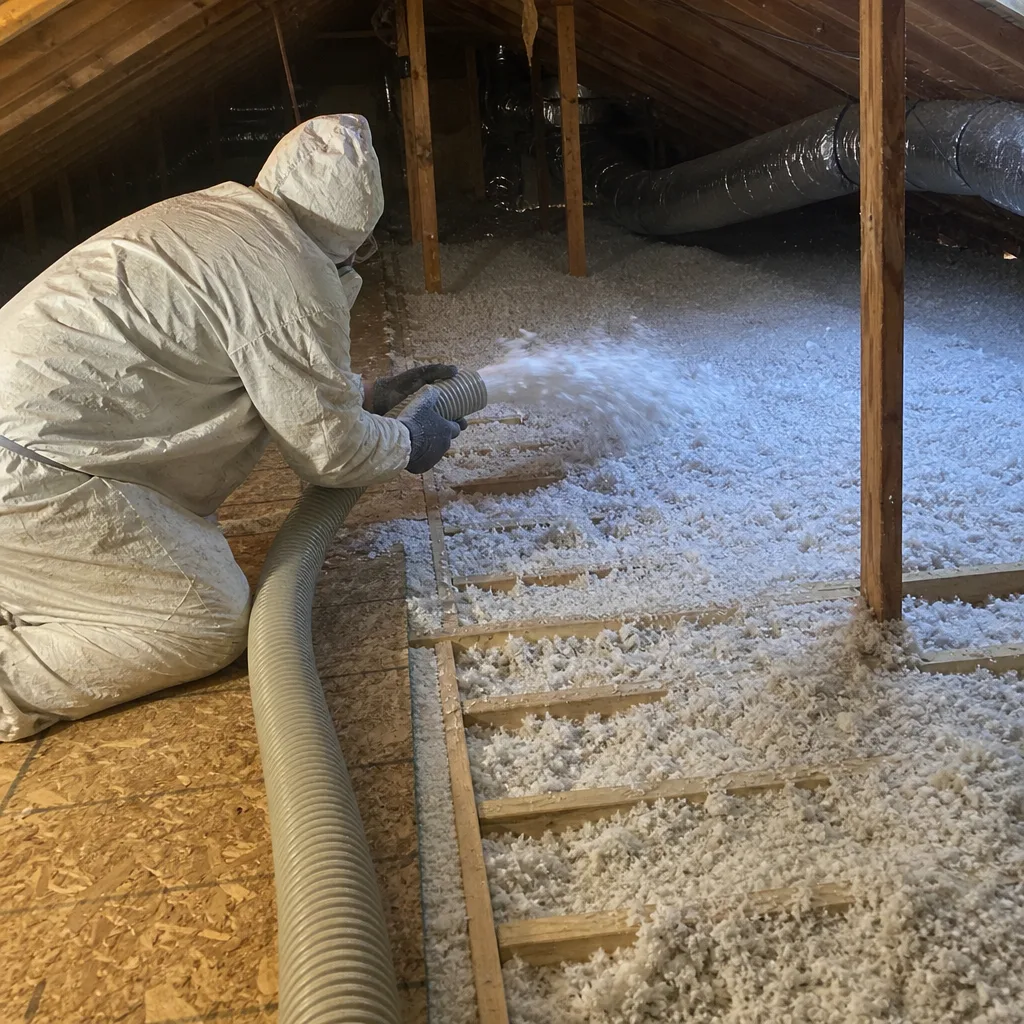
Blown fiberglass machines are available at Henderson Home Depot locations free with a material purchase, and for a homeowner with a straightforward attic top-off, that’s a real option. The machine you’ll get is a general-purpose blower with an adjustable feed gate, and its CFM output is not calibrated to your material or your attic. The result is that the density of your blow can vary from one end of the attic to the other, and the R-value you actually delivered is not the same as the R-value you set out to install.
Low-density blows can come in below the target by 20% to 30%. High-density blows cost you more material than you need. Neither shows up on a label until someone measures.
The fix, if you’re doing it yourself, is a depth gauge taped into the joists at multiple points plus spot checks every 100 square feet or so. Blow a pass, check your depths, adjust the feed gate, blow the next pass. That gets you close. It doesn’t get you a pressurization number. For the green-fiber approach specifically, our writeup on crawl space encapsulation and vapor barrier work in Henderson covers how the same verification logic applies below the floor.
Nevada C-2 Licensing and What It Means for Homeowners
A C-2 license in Nevada is the insulation and acoustical contractor classification issued by the Nevada State Contractors Board. It’s the license under which insulation work is legally performed as a trade. Here’s where homeowners need to be careful: the C-2 requirement applies to contractors performing insulation work for compensation. It does not apply to you performing work on your own owner-occupied primary residence. You can insulate your own house in Henderson without a C-2 license, and that’s true for most residential scopes.
What changes is what happens after.
- Insurance. Most homeowner policies do not cover workmanship defects in work you did yourself. If your attic insulation install leads to a moisture problem, a mold issue, or a failed air seal that lets water in at a rim joist, you’re likely on your own for the repair cost.
- Resale disclosure. Nevada requires a seller’s real estate disclosure form, and unpermitted or self-performed work that affects the building envelope is a disclosure item. Buyers in the Henderson market ask for documentation. A written scope and a blower-door reading close that conversation quickly. A verbal “I did it myself” doesn’t.
- Appraisal and inspection. A pre-sale home inspection will often flag visible insulation deficiencies. An appraiser valuing your home against comparable sales has no way to credit insulation upgrades you can’t document.
If you plan to sell within five years, this matters. If you plan to stay, the risk is more about the invisible failure you’ll pay to fix later.
The Decision Matrix: Four Factors That Point You One Way
If you want to skip the analysis and get to a call, this is the shortcut. The matrix below is the one we use when a homeowner asks us whether their scope is a DIY job. Score your project against all four. Any single “professional” answer overrides the rest.
- Scope type. Top-plate sealing, penetration sealing, rim joist foam, and spray foam all point professional. Attic top-off over documented air sealing, single batt replacement, and rigid foam on an accessible crawl wall point DIY-appropriate.
- Square footage. Under 400 square feet of new insulation, DIY is reasonable. Between 400 and 1,000 square feet, DIY is possible but the equipment calibration problem starts to bite. Above 1,000 square feet, the depth inconsistency plus the physical effort usually makes professional work cheaper on a per-R-value basis.
- Existing air-sealing documentation. If you have a written record of an air seal and a blower-door test within the past five years, you can proceed on the assumption that the envelope is intact. If you don’t have it, the assumption isn’t safe, and the scope becomes professional until the envelope is verified.
- Downstream need for a blower-door result. If you plan to claim a utility rebate on this work, sell within five years, or apply for an energy-efficient mortgage credit, you’ll need a post-install blower-door number. That number comes from a contractor, and the work behind it needs to be documented.
If any of those four lands on the professional side, a Henderson home insulation assessment from us includes the blower-door baseline and a written price before any work starts.
Henderson’s Climate and Why It Punishes Air Leaks
Henderson sits in the Mojave and runs a cooling-dominated climate, with summer design temperatures above 105°F and high attic temperatures that regularly exceed 140°F in the afternoon. That matters for insulation choice and it matters even more for the air barrier.
Every CFM50 of leakage in a Henderson home is conditioned air (already cooled by your AC) escaping into the attic or outside. The AC then has to cool a fresh load of 110°F outside air to replace it. In Anthem and Green Valley, where large two-story plans push a lot of supply duct into the attic, that leak load shows up as rooms that never quite get cool in August. In older Cadence and Calico Ridge homes, it shows up as a second-floor temperature differential of 6°F to 10°F between the front and back of the house.
Insulation alone doesn’t fix those. Air sealing does, and air sealing is the scope a blower door verifies. If we’re installing mineral wool from Rockwool or CertainTeed in a Henderson attic, we’re doing it after the air sealing is documented, not instead of it. Spray foam decisions in Henderson also need to account for the foam’s temperature window; our spray foam insulation service in Henderson walks through which product goes where.
Common Mistakes to Avoid
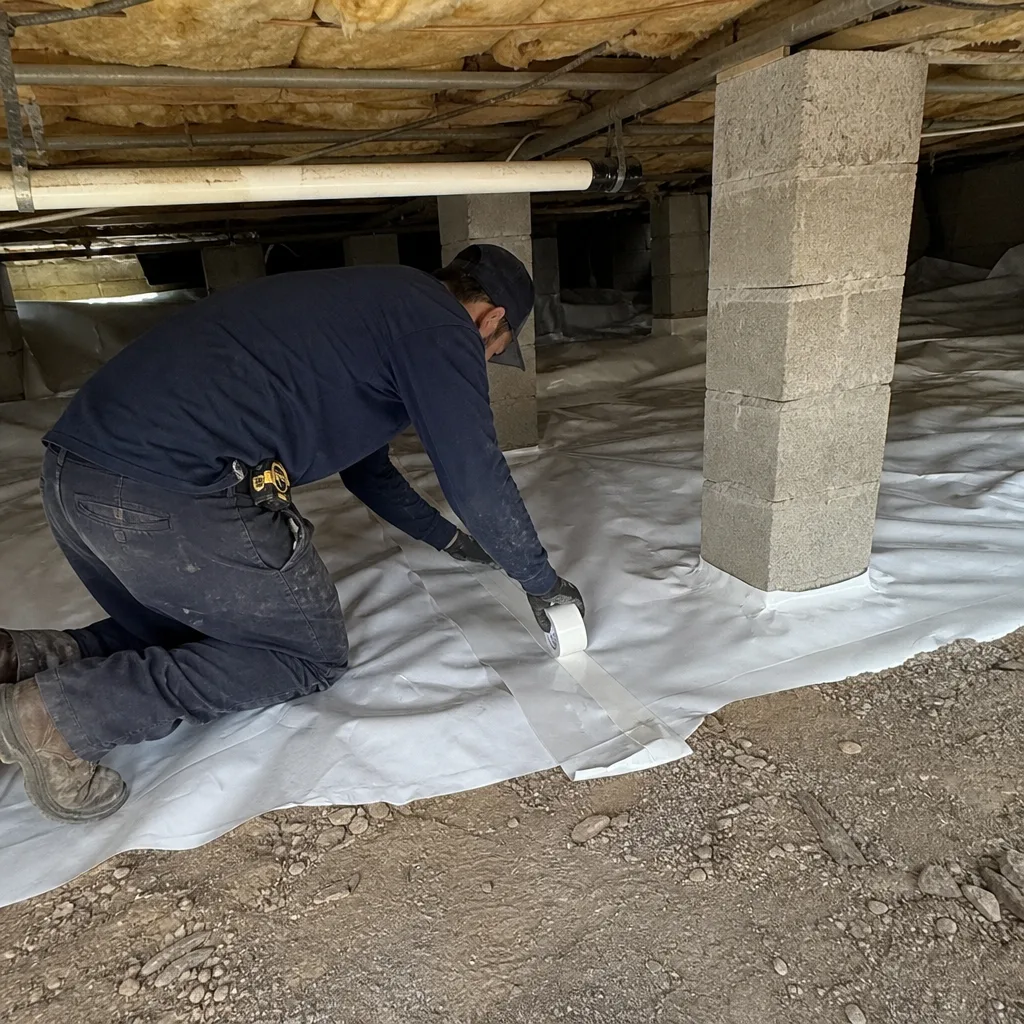
- Blowing insulation over an unsealed attic floor. We’ve seen this repeatedly in Henderson homes built in the 2000s. The new insulation looks complete, the bill doesn’t move, and the homeowner can’t figure out why. The air barrier was never sealed, and the new R-value just sits over gaps.
- Skipping the depth gauge and eyeballing the blow. Insulation installs are measured in inches per R-value, not by feel. Without a gauge at multiple points, you’re guessing at density and depth, and the R-value on the invoice won’t match what’s in the attic.
- Mixing faced batts into a hot attic. Faced fiberglass batts installed with the facing against an attic-side surface can trap moisture or create a vapor barrier in the wrong location for Henderson’s dry climate. Face everything inward or use unfaced material, and know which direction the vapor goes in your specific assembly.
- Using closed-cell foam in a cold-climate winter. Closed-cell foam (Icynene and Demilec included) needs a substrate within the manufacturer’s temperature window. A Henderson January morning in the 40s is often fine, but don’t assume. Check the spec sheet.
- Assuming the C-2 rule means DIY is illegal. It doesn’t. But it also doesn’t cover you for workmanship failures. Self-performed insulation work that goes wrong is a silent repair cost you won’t see until the moisture or the energy bill arrives.
- Treating “insulation” as a single trade. Envelope work is three trades in a trench coat: air sealing, insulation, ventilation. If your project touches only one of them, ask whether the other two need to be involved, and document the answer.
- Skipping the photo record. Take photos before and after, at every stage, whether you hire or do it yourself. Attic work is invisible after it’s complete, and having a visual record of what went in where and when will pay you back during resale or a warranty claim.
When to Call a Professional
Call a professional when the scope touches the air barrier, when the square footage is over 1,000 square feet, when you don’t have a blower-door test within the past five years, when you’re using spray foam, or when a downstream need exists for a verified number (rebate, resale, appraisal). Also call when the work is above your comfort level physically, and when you’re not sure. A free second opinion on a competing written estimate will cost you nothing and will tell you whether the price you have is structured correctly. Envelope Insulation Henderson offers free estimates in Henderson. Call (844) 320-5338 to schedule one.
Frequently Asked Questions
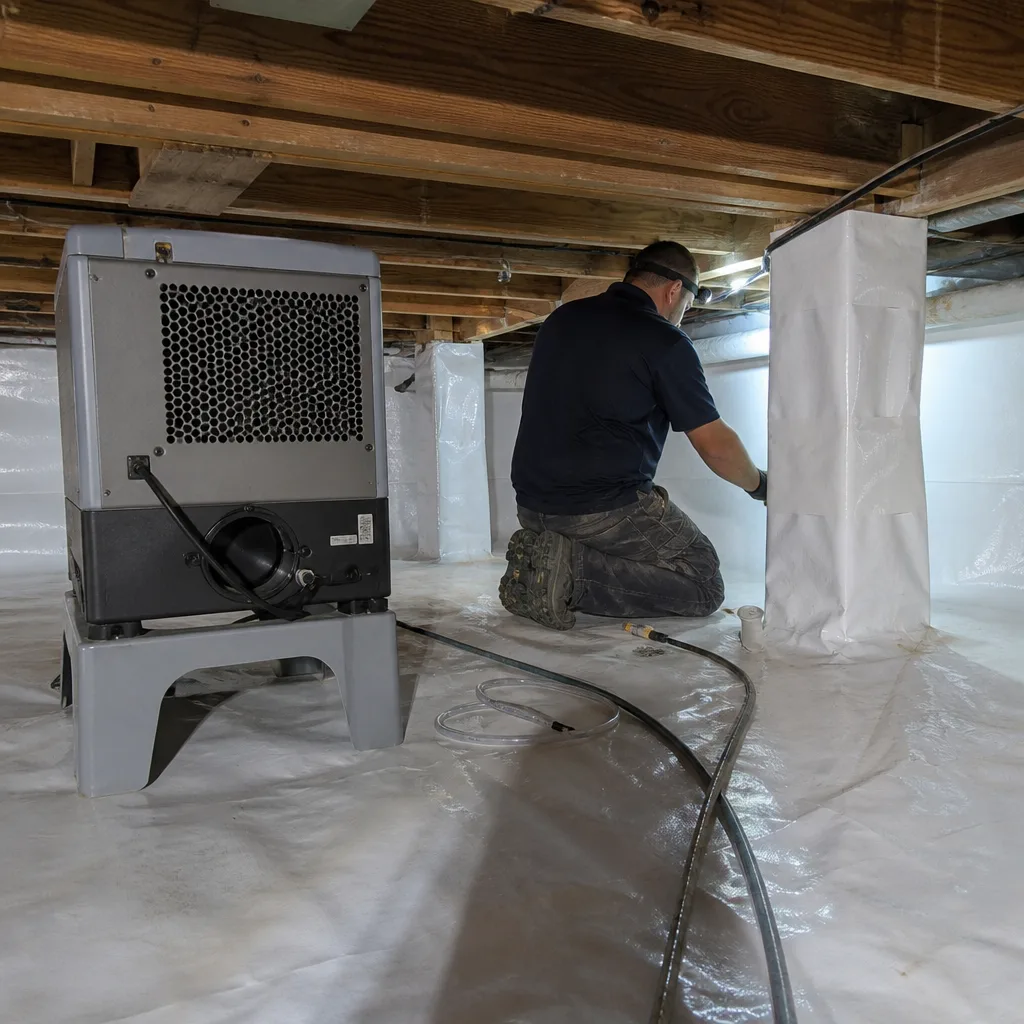
It can be worth it for adding depth to an already documented, air-sealed attic floor, replacing a single damaged batt in an interior wall, or installing rigid foam on an accessible crawl-space wall. For anything involving the air barrier, spray foam, or a large attic, the money saved rarely covers the risk of an unverifiable install. Call (844) 320-5338 for an exact quote if you want a professional comparison before deciding.
Yes, Home Depot in Henderson provides blown fiberglass machines with material purchase. The machine works, but its CFM output isn’t calibrated to your attic or your material, so consistent density requires a depth gauge and spot checks every 100 square feet or so. If your project is under 400 square feet, that’s workable. Above 1,000, professional installation usually delivers more verified R-value per dollar.
No, you do not need a Nevada C-2 license to insulate your own owner-occupied primary residence. The C-2 requirement applies to contractors doing insulation work for compensation. What changes without a contractor is your insurance coverage, your ability to document the work for resale disclosure, and your access to a post-install blower-door reading. Call (844) 320-5338 if you want a free second opinion on a written estimate and documentation of what a verified install looks like.
A blower-door test is a pressurization measurement that reports the CFM50 your building envelope is leaking. It’s the only way to know whether air sealing actually worked, and it requires calibrated equipment that costs roughly $3,500 to own. That’s the single biggest reason a DIY install over an unsealed attic floor can fail silently.
Most attic insulation jobs in a Henderson home in the 1,200 to 2,000 square foot range land between $2,800 and $5,400, depending on whether air sealing is included, the target R-value, and access. Air sealing alone on a typical attic runs $900 to $1,800. Call (844) 320-5338 for an exact quote, and bring us a competing written estimate for a free second opinion.
It can, but the effect is often small, and the reason is that insulation’s job is conduction, not air movement. A blower-door reading before the work tells you how much of your energy loss is air leakage, and that tells you where the money should go first. If your envelope reads above 3,500 CFM50, air sealing should happen before insulation. Call (844) 320-5338 to schedule a home energy audit.
The Bottom Line
DIY insulation isn’t a skill question. It’s a verification question. Adding R-value over a documented, sealed attic floor is a reasonable homeowner project. Touching the air barrier, applying spray foam, or working on an attic with no recent blower-door reading is not, because there’s no way to confirm the job worked when it’s done. In Henderson’s cooling-dominated climate, air leakage drives more of your energy bill than the R-value label on the insulation. Get the envelope verified first, then decide whether the install itself is a weekend project or a professional call. And if you want the number, we’ll measure it.
Call (844) 320-5338 for a free estimate. Every job starts with a written price and a written scope before any work begins, and closes with a Documented Photo Record and before-and-after blower-door numbers on applicable work.
Written by the team at Envelope Insulation Henderson.