
What R-Value Do You Need for Attic Insulation in Henderson, NV?
For a Henderson home in Climate Zone 3B, the target is R-38 at minimum and R-49 if you want the upgrade to pay for itself. But the number on the bag only matters if your attic floor is air-sealed first. An unsealed attic with R-49 blown over it can lose the equivalent of 30-40% of that nominal R-value to stack-effect air movement, and no amount of depth fixes a gap. If you want the short answer measured against your actual attic rather than a map, call (844) 320-5338 and we’ll walk you through it.
The DOE climate map puts Henderson in Zone 3B and recommends R-38 to R-49 for attic insulation. That’s the right target. What the map can’t tell you is that hot attic air at 150°F doesn’t respect R-value when it has a gap to flow through. On a July afternoon in Green Valley, that’s the whole ballgame.
Why the Climate Zone Answer Is Right but Incomplete in Henderson
Henderson’s cooling season runs roughly May through September with sustained 100°F+ days, and attic temperatures here regularly push past 160°F. That changes the economics. In a cold-climate market, attic insulation is mostly about holding winter heat in. Here it’s almost entirely about rejecting summer heat, which is why R-38 is the floor and R-49 is the sensible upgrade: it shortens the payback window in a city where the AC runs five months straight. Going past R-60 in this climate produces diminishing returns. You’re paying for material that never gets a chance to work.
The distinction that matters is nominal versus effective R-value. Nominal is what the product is rated for in a lab. Effective is what your assembly actually delivers in a real house with real penetrations. The gap between the two is measured by a blower-door test, a pressurization reading that shows in one number how much air your building envelope is losing. In an un-air-sealed Henderson attic, that gap is routinely large.
What Your Attic Probably Started With (and What’s Left of It)
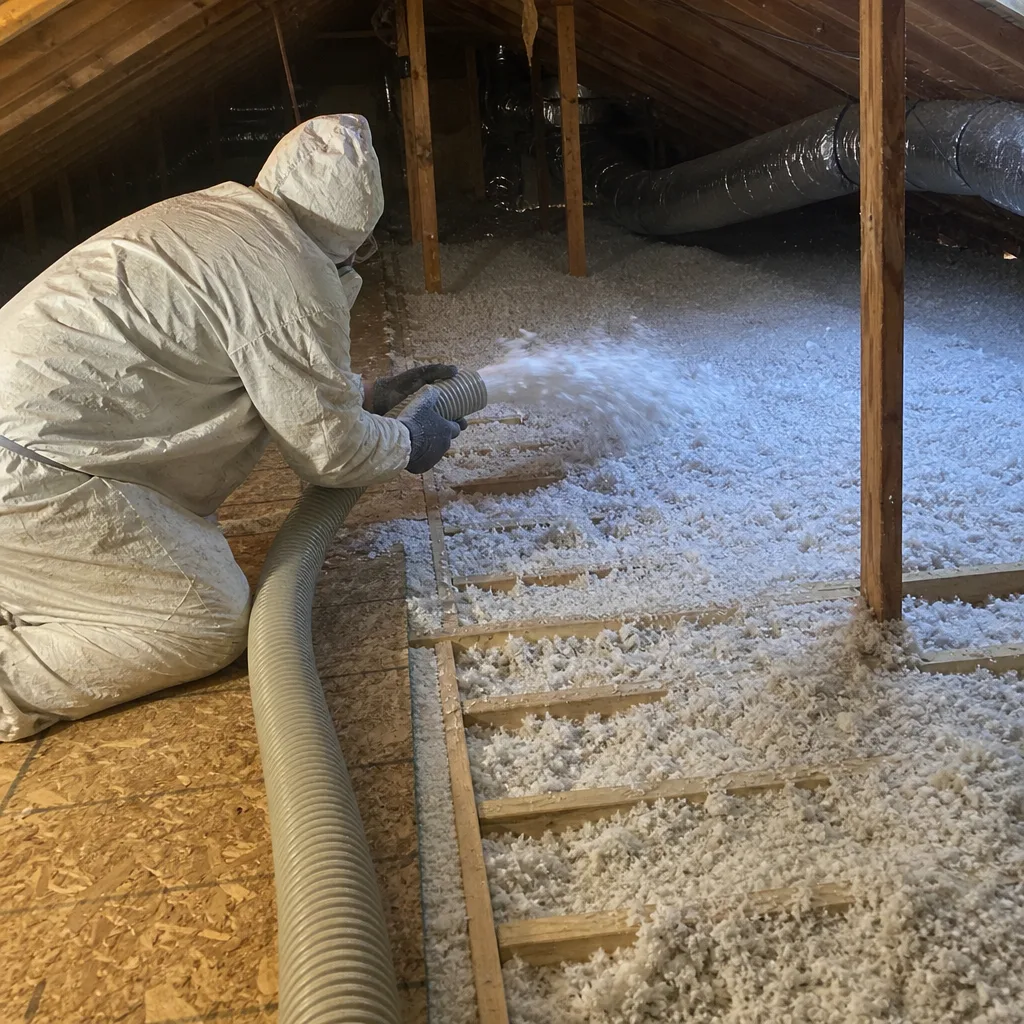
Henderson is dominated by planned-community tract housing built from the late 1980s through the 2010s, in places like Green Valley, Seven Hills, Anthem, and Inspirada. Wood-frame stucco homes, mostly, with builder-grade R-13 batts or blown insulation that was never generous to begin with. Thirty years on, that material has settled, compacted, and been disturbed. Original R-13 batts from the 1990s often test out at R-9 or R-10 effective today.
Two local factors make it worse than the age alone would suggest. Solar installs on Henderson’s sun-baked roofs routinely compress or displace the insulation beneath the array, creating hidden hot spots the homeowner never sees. And pack rats and roof rats tunnel through attic batts and nest in blown-in cellulose, shredding both the material and its R-value. The actual starting point is almost always worse than the builder’s spec sheet said.
How We Measure What You Actually Have
Before any insulation goes in, we measure existing depth at five or more points across the attic floor and calculate current effective R-value from those readings. The written scope then specifies exactly how many inches of blown-in are needed to reach your target. Not “up to R-38,” not a range pulled from a chart. A number, in inches, tied to your attic.
The measurement matters because Henderson’s master-planned subdivisions repeat street to street: uniform roof styles, tight lot lines, the same attic access and venting configurations house after house. The variation is inside, not outside, and the only way to price it honestly is to look.
| Attic condition | Typical target | Typical installed cost |
|---|---|---|
| Air-sealed attic, settled R-13 to R-19, top-off to code | R-38 | $1,100-$1,900 |
| Air-sealed attic, upgrade for faster cooling payback | R-49 | $1,600-$2,600 |
| Air sealing added first (top plates, can lights, penetrations) | Prerequisite | $600-$1,400 |
| Removal of rodent-damaged or compressed material, then reinstall | R-38 to R-49 | $2,200-$3,800 |
We use blown-in from GreenFiber, CertainTeed, and Knauf depending on the attic, and we don’t lock you into a proprietary product. What you’re paying for is performance you can verify. Under The Haven Standard, every job starts with a written price and ends with a documented record, and on applicable jobs we publish before-and-after blower-door readings so you can see the ACH50 change for yourself. Not “we significantly improved your home’s efficiency.” A number, before and after.
Air Seal First, Insulate Second: The Order Is Not Optional
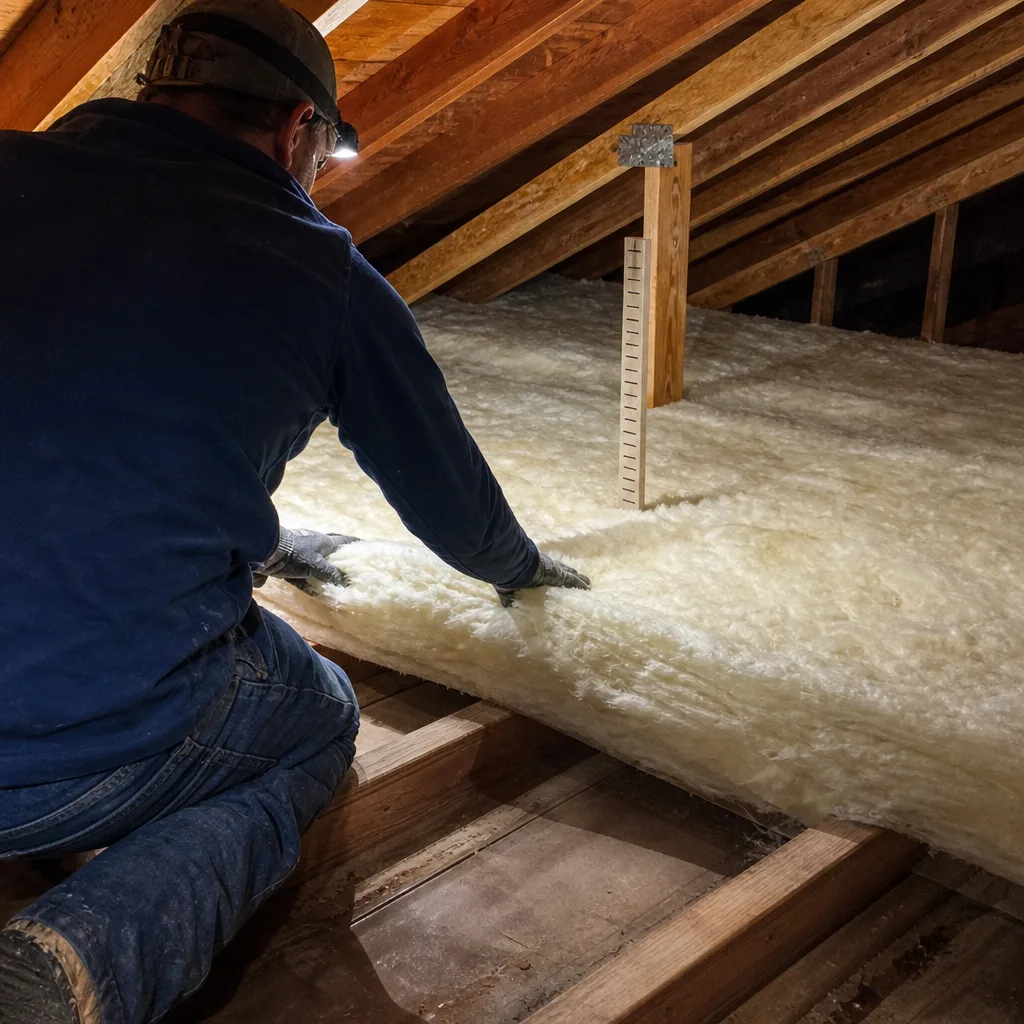
This is where most of the money leaks out. We seal top plates, can-light housings, and mechanical and HVAC penetrations across the attic floor before a single bag of insulation goes down. Adding R-value over an air leak is spending money on a problem that isn’t fully solved. The attic stays hot, the ducts stay hot, and the AC keeps running.
On our typical Henderson jobs, the blower-door reading comes in around 4,200 CFM50 before sealing and drops toward 2,100 after. That’s the part of the work the R-value question doesn’t capture, and it’s the part that determines whether your new R-49 performs like R-49 or like a very expensive suggestion.
When to Stop Researching and Have It Looked At
If you’re comparing a bag of blown-in you can buy at a home center against a contractor quote, there’s a reason the numbers don’t line up: the bag gives you nominal R-value, and your attic gives you whatever survives the leaks and the heat and the rodents. That’s not a sales pitch, it’s the physics. If you’d rather have someone measure your actual starting point before deciding between R-38 and R-49, our technicians have up to 10 years of experience and a free second opinion on any written estimate you’re holding.
Frequently Asked Questions
R-38 is the minimum for a sealed attic in Henderson and R-49 is the upgrade we recommend for most homes, because the cooling season here runs five months. Anything above R-60 has diminishing returns in Climate Zone 3B. Call (844) 320-5338 and we’ll measure your attic and tell you where you actually stand.
Air sealing first is the cheaper path to a real result, typically $600-$1,400 before any insulation goes in. Sealing top plates, can lights, and penetrations stops the air movement that makes new insulation underperform, so you get the full value of whatever R-38 or R-49 you add. For an exact scope on your attic, call (844) 320-5338.
You measure the depth at several points and convert from the settled material’s known value, which is what we do before quoting. On a 1990s Green Valley or Anthem tract home, the original R-13 batts often test out at R-9 or R-10 after settling, solar arrays, and rodent damage. Estimates are free, and we’ll show you the readings. Call (844) 320-5338.
Not meaningfully once the attic is sealed and the material is at R-49. In Henderson the dominant load is summer cooling, and the return on extra depth flattens out past R-60. The better money goes into air sealing and radi ant-barrier work first. Call (844) 320-5338 to talk through the tradeoffs on your specific house.
If you’d rather have it looked at, Envelope Insulation Henderson offers a no-pressure assessment in Henderson. We’ll measure your attic, seal it if it needs sealing, specify the inches of blown-in that get you to R-38 or R-49, and hand you the written price before anyone lifts a tool. Call (844) 320-5338 for a free estimate, and see our Insulation Installation in Henderson page for what the full scope looks like.
Written by the team at Envelope Insulation Henderson, serving Henderson, NV.